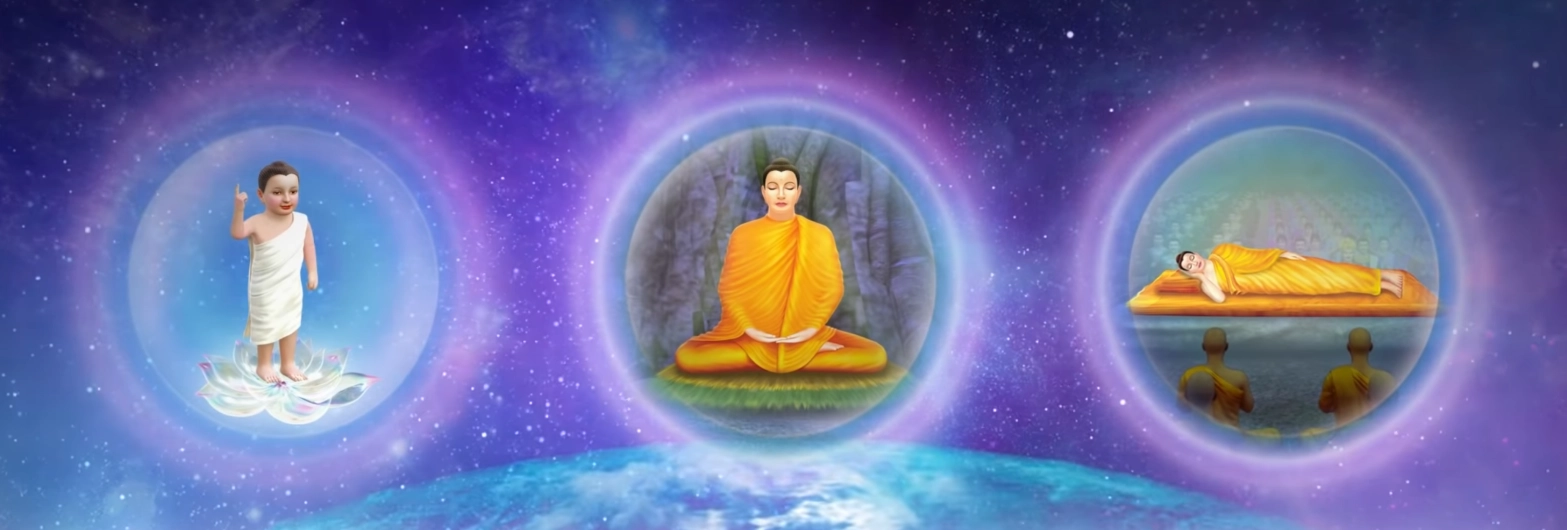
The United Nations has defined Vesak Day to be an internationally important day of the world. On 15 December 1999, the 54th General Assembly of the United Nations considered Agenda 174 International recognition of the Day of Visak stating that Buddhism is one of the oldest religions in the world, which has long guided the way out of suffering for mankind. It should be praised all over the world, therefore announcing the Visakha Bucha Day which falls on the full moon day of May It is an international day.
Vesak Day, also known as Buddha Purnima is a significant Buddhist festival that memorializes the birth, enlightenment, and death (Parinirvana) of the Lord Buddha, the founder of Buddhism. The observance of Vesak Day provides several lessons and insights that can be learned:
Birth
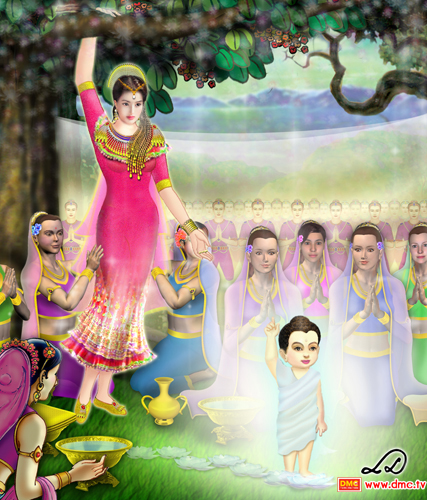
Before the Buddhist Era 80 years ago (623 BCE), at Lumphini Park, located between Gabiropolis and Tevetah City, on the full moon day of the 15th night of the sixth month, it was the day that the Lord Buddha was born onto the earth. Queen Sirimahamaya, who was the mother of the Lord Buddha, had a clear mind due to her practice of meditation and keeping precepts. She saw the Bodhisattva (Buddha-to-be) in her womb, meditating, just like a Buddha. The bodhisattva was meditating outside her womb.
When the time came for the Buddha to be born, it was found that the Queen was able to stand up and give birth while holding onto a branch of a tree. As soon as the Buddha was born, he stood up and walked, which was an incredible miracle. Once the Buddha was born and able to stand and walk, he spoke his first words, declaring his purpose for being born as:
“I am the supreme being, the most sublime being in the world. This is my final rebirth. There is no more round of rebirth for me.”
It seems unbelievable that someone can walk and talk at birth, but if we study his history in his previous lives, we will find that he had a strong determination to train himself, practice, and build perfected virtues for a long time. No matter how difficult the obstacles were, he never gave up and kept aiming to become a Buddha. This is even more incredible and inspiring. If you have a goal, then go for it and declare it to reinforce your goal even more.

In his first life which become Bodhisattva, he was just an ordinary person, impoverished. Once he worked on a ship and took his elderly mother with him. However, when the ship sailed out, it encountered a storm and many people died, some were eaten by sharks, some froze to death, and some drowned. But he didn’t die. he tried to swim and carry his mother on his back. At that moment, he realized that life is full of suffering. Is there any way to escape from it? And if he finds a way to escape, he will help others to escape as well. With this thought, he developed great determination and strength. He was able to swim and carry his mother to shore safely. From that moment on, he was called the “Bodhisattva.”
This shows that we can change ourselves, even if we have a bad starting point. And if we compare ourselves to him at that time, we have more resources than he did. Therefore, there is nothing that is impossible.
Enlightenment

When the Prince grew up, he left the palace and saw different types of people he had never seen before, including the elderly, sick, dying, and ascetics. He realized that the path of asceticism was the noblest path to escape suffering. Therefore, he left his luxurious life and became a monk at the age of 29. He practiced asceticism for six years, but he could not achieve enlightenment. He realized that there were two extreme paths to follow: the path of pleasure like the one he had before and the path of extreme asceticism, which did not lead to enlightenment. He understood that the Middle Way was the only path that could lead to liberation.
He abandoned asceticism, returned to a normal life, and practiced meditation. He said,
“As long as I have not attained the ultimate truth, even though my blood and flesh dry up and I am left with only skin and bone, I will not leave this place.”
He meditated until he found the Middle Way and achieved enlightenment on the night of the full moon in the sixth lunar month. He became the Buddha, the enlightened one, under the Bodhi tree.
This story teaches us that success comes from doing things in the right way. If we don’t follow the right path, we won’t succeed no matter how hard we try. In the beginning, we may need to trial and error before finding the right path to success.
As ordinary human beings, we may not be able to dedicate our lives to seeking enlightenment like the Buddha. However, we can use what the Buddha discovered and apply it to our own lives. This means training the mind to find inner peace and happiness within us. When we are able to do that, we will be complete within ourselves and not rely on external sources for our happiness. We will have an abundance of happiness to share with our fellow human beings.
The Great Decease of the Buddha
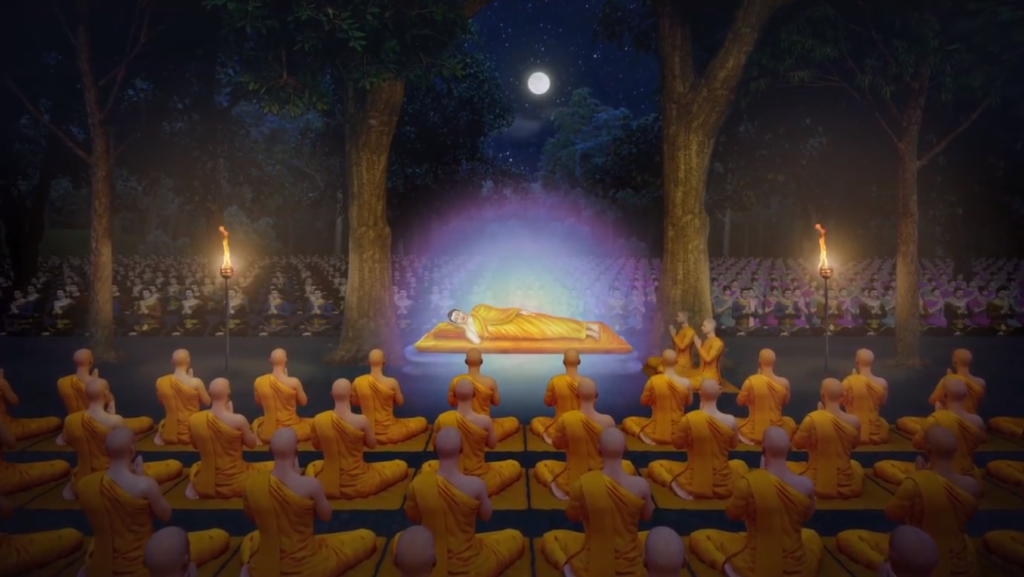
Lord Buddha spent 45 years spreading the teachings of religion for the benefit of humanity. While staying at the Paval Chedi on the full moon day of the third month, he declared that “in three months from now, I will pass away and enter Nirvana”. During those three months, he prepared for his passing and made sure to make things more convenient for everyone. He also settled all matters in order for Buddhism to be firmly established, ready to be the triumph of humanity as long as possible.
Before entering Nirvana, Lord Buddha acted as a teacher for the last time, asking if anyone had any doubts or questions about his teachings. However, no one had any doubts or questions. Monk Anon said, “It is truly wonderful that not a single monk has no doubts or questions about the Triple Gems and any practices at all.” Then, the Lord Buddha gave a final sermon to all the monks, saying,
“All of you, I warn you for the last time that all conditioned things undergo changes. Decay is a normal process. All of you must not be reckless. You must hurry to find your refuge.”
After giving his final warning, Lord Buddha entered Nirvana by meditative attainments at nightfall on the full moon day of the sixth month when he was 80 years old, exactly as he had predicted. The graceful passing was witnessed by Monk Anuruddha, an excellent clairvoyant disciple. After seven days of passing, a ceremony was held to offer a funeral pyre to the Buddha on the eighth day of the sixth month, which is now known as “Atthami Puja Day”.
What we learn is that everything has to arise, exist, and deteriorate over time, even though the Lord Buddha who overflowing with virtues, he still had to face the end of his life. However, the Buddha does not have to be reborn again, he has attained eternal happiness in Nirvana forever. Therefore, we should not cling to things that are not meaningful in life. We should seek happiness within ourselves, which comes from calming and stilling the mind. Since we cannot know the day of our death like the Lord Buddha, we should not be careless and always be prepared.
Overall, Vesak Day serves as a reminder to individuals to cultivate determination, follow the right path, seek inner peace, and embrace the transient nature of existence. By embodying these teachings, individuals can lead more fulfilling and meaningful lives.
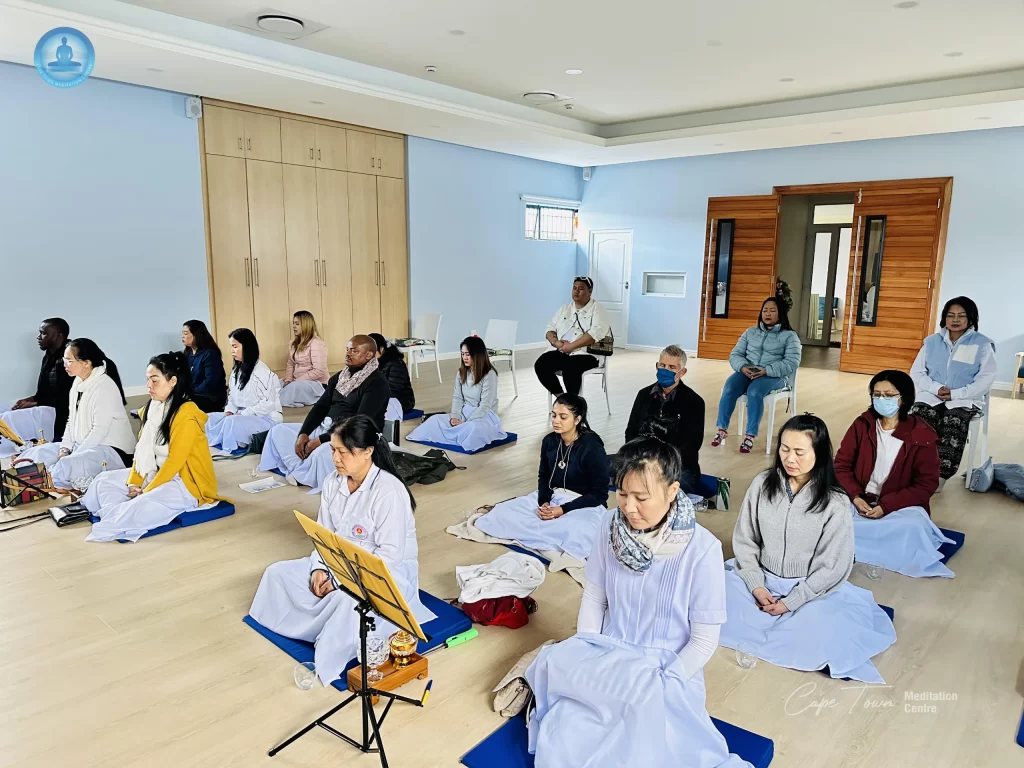
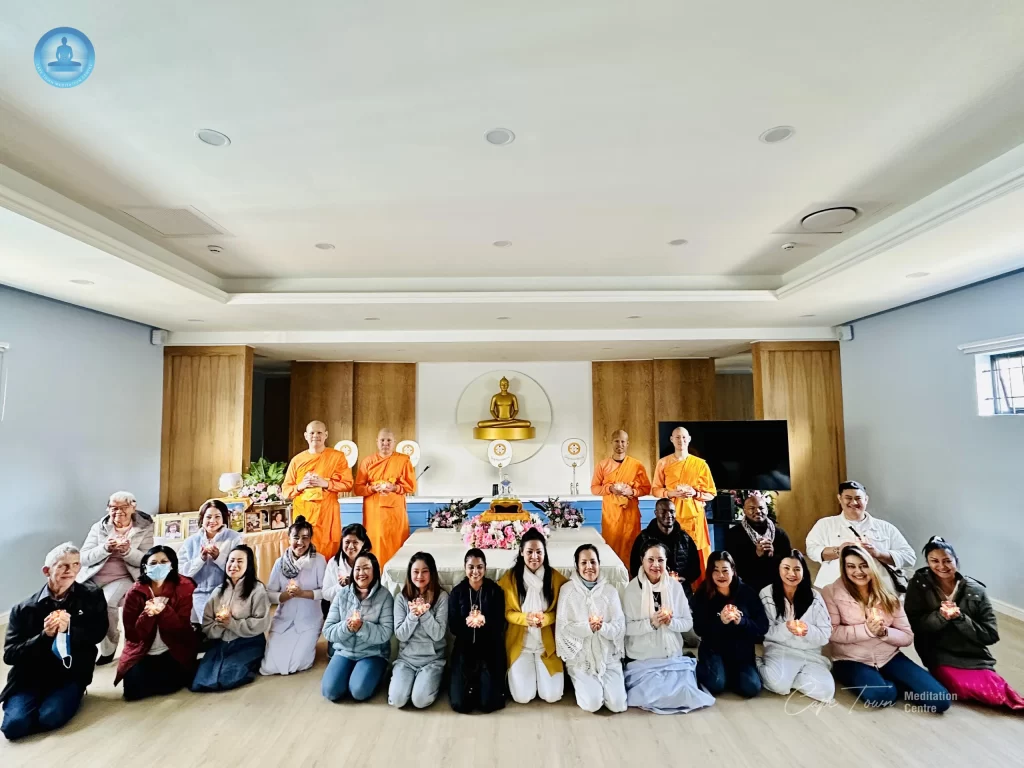
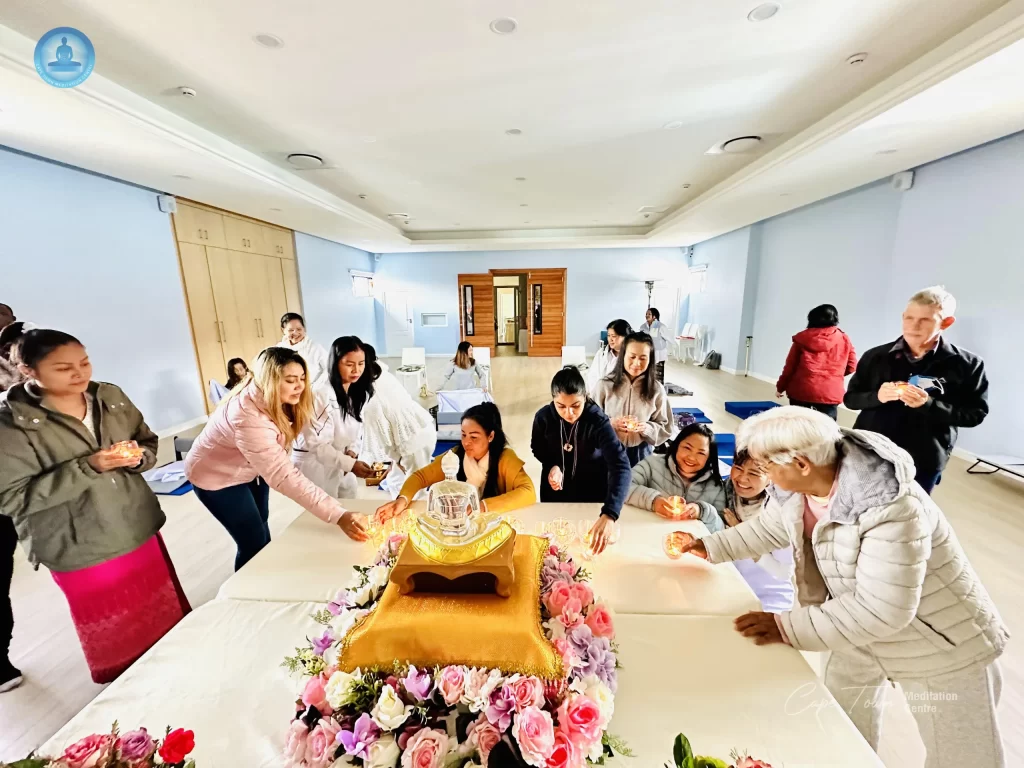
On the occasion of Visak Day, Thai and local people who are interested in Buddhist culture came together to practice meditation and light up a candle to worship the Buddha together at Cape Town Meditation Centre.
