

The End of Buddhist Lent marks a deeply meaningful moment in the Buddhist calendar. It is the day when the monks complete their three-month retreat during the rainy season, and it is also the day Buddhists commemorate the great event when the Lord Buddha descended from the heavenly realm back to the human world after teaching the Abhidhamma to his mother in the heaven of Tavatimsa.

On that sacred day, the Buddha revealed the three realms — the heavenly world, the human world, and the lower worlds — so that beings in all realms could see one another. It was a rare moment that filled countless hearts with faith and inspiration. Some made the aspiration to become Buddhas in the future, while others developed deep understanding and determination to walk the path that leads out of suffering.
It doesn’t mean only human and animals but includes beings in other realms that we cannot normally see. Among them were the Nāgas who were present and witnessed that sacred event more than 2,500 years ago. With deep reverence and joy in their hearts, the Nāgas wholeheartedly breathes out glowing orbs that rise into the sky every year on the day marking the end of the Buddhist Lent as an act of homage and a remembrance of the boundless virtues of the Buddha.
The Mysterious Fireballs of Ended Lent
Every year, on the full moon day of the 11th lunar month—the day marking the end of Vassa—something extraordinary is said to occur along the Mekong River, especially in Nong Khai and Bueng Kan provinces (in northeastern Thailand). At night, glowing orbs of fire rise silently from the surface of the river and drift upward into the sky. These fireballs have no scent, no smoke, no sound, and they do not arc downward.
On that evening, many people from nearby provinces and even farther away journey to sit by the riverbank and watch. They count the fireballs as each is emitted, one after another, with joy, curiosity, and awe.
Over time, scientists and enthusiasts have tried to find natural explanations—perhaps gas emissions, electrical phenomena, or human-made lanterns. But no definitive scientific evidence has explained them. Meanwhile, some meditators and those with spiritual insight claim that these fireballs are produced by Nāgas. On some occasions, even ordinary villagers report glimpsing a Nāga directly.
Those who describe what they see often say: a large serpent, majestic, with a crest or crown. The author believes that ancient people must have seen similar beings and described them in their own way. That’s why in different cultures we find similar stories — like the dragon in Chinese tradition, which is very close to how we describe the Nāgas. But in Western stories, dragons look quite different — yet they still share one thing in common: they can breathe fire.

Fire-Breathing Nāgas and the Eight Precepts
The Nāgas do not simply breathe fire at random. The ability to emit the glowing fireballs is said to depend on their virtuous conduct. Specifically:ref.
- The Nāgas must maintain the Eight Precepts continuously during the entire three months of Vassa (the rainy-season retreat).
- They must descend from their heavenly or subterranean dwelling (vimāna) and live in the river or underground during that period. If they remain in their own celestial abode, they are subject to distractions, especially from female Nāgas (nāgīs) who may tempt them; thus their discipline would not be pure.
- By persevering in purity, restraint, and abstention through the entire retreat, they accumulate enough merit and spiritual power. At the close of Vassa, the merit they have gathered is transformed into multi-colored fire orbs, which they send upward as an offering and homage to the Buddha.
Thus, the fireballs are not a show but a manifestation of deep spiritual practice—a kind of luminous tribute.
Nāgas in Buddhist Cosmology
In the Pāli Canon and later Buddhist texts, Nāgas, Pañyā Nāga, or Nāgarāja (king of Nāgas) are semi‐divine serpent beings. They are categorized under direṭṭhadhamma (animal realm) but with celestial qualities. They dwell under the earth or in watery realms. Their modes of origin include:
- From eggs
- From a womb
- From moisture (or bodily fluids)
- Born fully transformed (i.e. spontaneously)

Within these categories there are four clans: golden body, green body, rainbow (iridescent) body, and black body.ref.
The texts also explain causes for rebirth as a Nāga: some humans, hearing of the long life, beauty, and happiness of Nāgas, cultivate merit with the aspiration to become a Nāga.ref. Others, whose minds are mixed with both merit and sensual desire, may also land in the Nāga realm—powerful, but still bound by craving.
The lifespanref. of the Nāga is uncertain. Some live for only a few years, while others live for an incredibly long time. Those with great longevity may survive through the eras of many Buddhas.

For example, Phaya Kala Nakaraja has lived since the time of Buddha Kakusandha, Buddha Konagamana, Buddha Kassapa, and continues to live into the present era of Buddha Gotama — and will still remain until the future Buddha Metteyya (Maitreya) arises.
On the day before Prince Siddhartha attained enlightenment, he made a solemn wish and released a golden bowl into the river, praying that if he was truly destined to become a Buddha, the bowl would float upstream against the current.
Miraculously, the golden bowl floated upstream and then sank gently into the Neranjara River. Deep below, Phaya Kala Nakaraja heard the sound of the bowl touching the riverbed. Awakened from his slumber, he exclaimed, “Oh! The fourth Buddha has now arisen in the world!” Then, with serene joy, he returned to rest.
The author therefore believes it is possible that the Nāgas possess an exceptionally long lifespan, and that they have lived long enough to witness the miraculous moment when our present Buddha truly opened the world with his power.
Why the Nāgas Appear in Thailand, Not India
You might wonder: if the Nāga stories originate from early Buddhist traditions in India, why do we see these fireball phenomena only in the Mekong region of Thailand, not in India? Shortly I offer a possible explanation drawn from lore:
In the early Buddhist era, Nāgas living under the Ganges (Ganga) River or the Neranjara (Neranjara River)—regions closely tied to the birthplace of Buddhism—also once emitted fireballs and even made aspirations to become future Buddhas. But later, as Buddhism declined or was displaced in parts of India and human societies changed, many people migrated, changed beliefs, or adopted other faiths. The human karma (actions) and belief systems shifted strongly, affecting even the Nāgas.
In those human communities, many worshipped gods or spirits who were not the Triple Gem (Buddha, Dhamma, Sangha). They followed belief systems of idol worship, folk deities, or faiths that did not lead to deep wholesome joy (pīti). Because of that, their merit was weak, their minds unsettled, and their spiritual power diminished. Thus, the Nāgas in those regions lost the capacity to purify themselves fully enough to manifest the fire orbs.
As time passed, divisions among deities, angels, spirits, and beliefs increased. Those beings who maintained a correct view and devotion to the Triple Gem became marginalized and sometimes oppressed by competing spiritual beings. Eventually, many of the Nāgas and devas who supported Buddhism in those ancient riversides migrated or retreated to areas more conducive to their faith—particularly in regions along the Mekong, where Buddhism continues to flourish.
Along the Mekong, many Nāga cities emerged, growing from small groups near Phon Phisai, Rattanawapi, and Sri Chiang Mai districts in Bueng Kan province. The capital city was governed by Okintra Nāgarāja, with the city of two Nāgā queens as subordinate realms, ruled by nāgī queens who were once daughters of earthly kings. When Vassa arrives, the Nāgas descend from their celestial dwellings to the riverbanks or underwater caves near the Mekong and practice ascetic virtue. They congregate in river hollows, water-caverns, or underground chambers, keeping strict observance and avoiding all sensuality. It is from such dedicated practice that their merit becomes luminous fire. These luminous orbs ascend through the water into the sky, visible to people on both riverbanks, just at the time when human devotees also light incense and candles in homage to the Triple Gem.ref.

Thus, the Nāga fireballs are unique to the Mekong region because the Nāgas there remained true to Buddhist faith, maintained correct view (sammā diṭṭhi), and kept the purity necessary for such manifestations.
The author believes that if the people of South Africa come together in goodness — purifying their minds through mindfulness and meditation, and radiating love and compassion across the land — the pure energy they generate will be felt by beings living in realms that coexist with ours: celestial beings, wandering spirits, and even local “Nāgās” who still hold faith and may one day perform such wondrous acts here as well.
The suffering of the Naga who longs to be freed from being a Naga
Although Nāgas enjoy more comfortable lives that came from their past good deeds as humans,
they still have their own kind of suffering. Because of their body and nature.
They also have limitations: their serpentine form makes physical austerity and deep meditation difficult. Because their bodies move horizontally rather than upright like humans, they cannot find the center of the body — the gateway to true inner peace.
One old story tells of a Nāga who, weary of being a serpent, used magical power to transform into human form in order to ordain as a monk. But sustaining that human guise proved exhausting. One dawn, his concentration lapsed and his serpent body returned in the monk’s dwelling. The other monks were shocked and brought him before the Buddha.

Out of compassion, the Buddha told him:ref.
“You are a Nāga , and by nature you cannot progress in this Dhamma and Discipline.
But go, dear Nāga. On every Uposatha day, keep the Eight Precepts purely.
By doing so, you will soon be freed from the Nāga form and be born again as a human being.”
From that event comes the tradition of asking, “Are you a human being?” before ordaining new monks — a reminder that only humans can walk the path to enlightenment.
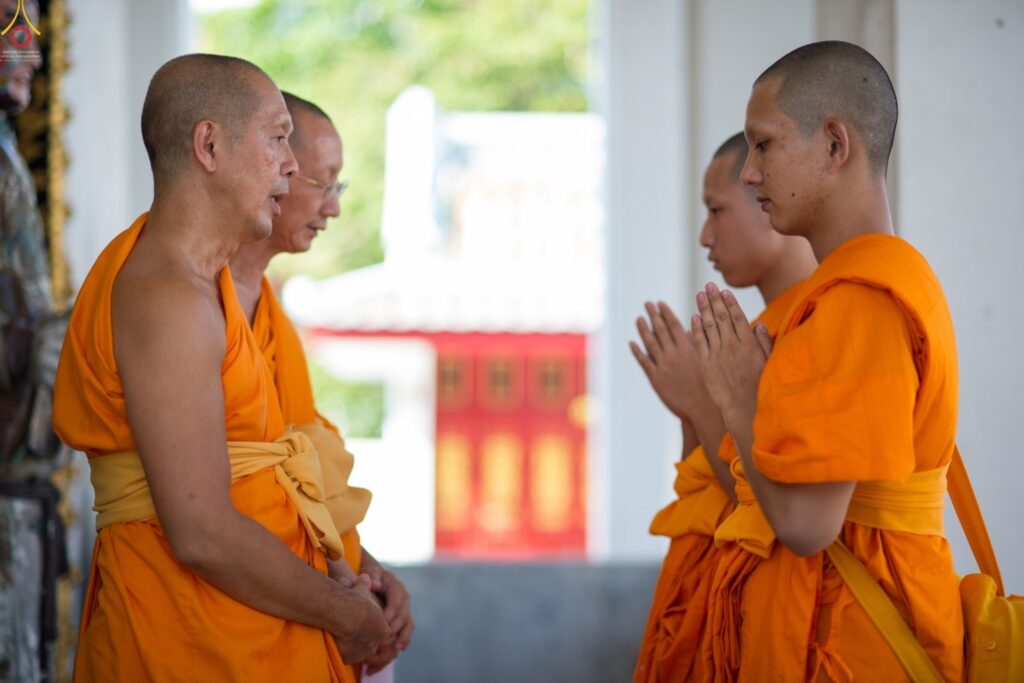
From such stories arises the tradition in ordination ceremonies of asking, “Are you human?” as a preliminary question.
Invitation to Reflection
This coming End of Buddhist Lent, as you watch the fireballs or hear the stories, consider:
- Human beings have the unique potential to cultivate inner peace and wisdom. The Nāgas, powerful though they are, need conditions we humans can generate through moral effort.
- Cherish and take good care of this human body, for it is the only form through which we can fully create merit and do good deeds. Most importantly, the human body stands upright — perpendicular to the earth — allowing us to find balance and discover the center of the body, the point that connects us to the realm of true happiness and wisdom, leading to genuine peace.
- There are still many mysteries waiting for us to uncover. The event of the Three Worlds Opening during the Buddha’s time — and the continuing phenomenon of the Nāga Fireballs — serve as reminders and inspiration for us, the people of this era, to embark on an inner journey in search of the truth.
- Sometimes, reasoning alone — cintāmaya paññā, wisdom gained through thinking — is not enough. We must rely on bhāvanāmaya paññā, the wisdom born of meditation — the true science of the mind.
“Do not believe blindly, but come and see for yourself.” — The Buddha
May these reflections help readers from many lands appreciate how deeply our beliefs and practices intertwine with natural wonder, myth, and the aspiration toward awakening. May all beings be touched by the light of Truth.
After finishing this reading, the Author’d like to invite you to enjoy this beautiful song. Though it’s in Thai, it also comes with English subtitles for you to follow along.
