

Introduction: How Do We Understand the World?
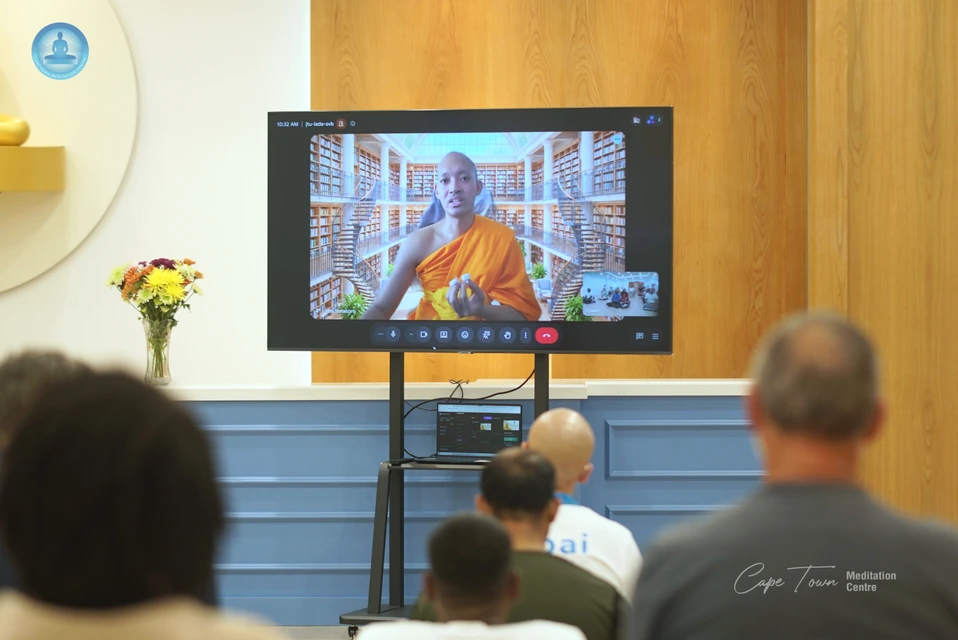
Every day, we experience the world around us. We see, hear, touch, think, and feel. However, have we ever stopped to consider whether we truly understand everything we experience?
Sometimes, what we see is only a small part of reality.
Imagine looking up at the night sky. With our naked eyes, we may see only a few shining stars. But when scientists developed more powerful telescopes, they discovered countless galaxies beyond what the human eye could see.
Similarly, when we look at a glass of water, it may appear completely clear. Yet, with the help of microscopes, scientists can discover tiny organisms that are invisible to the naked eye.
The world did not suddenly become more complicated. We simply developed better ways of seeing it.
This raises an interesting question: What if the same principle applies to our own minds?
We experience anger, fear, desire, happiness, sadness, and suffering every day. But do we always understand where these feelings come from? Do we recognize when they begin? And do we understand how they influence our thoughts, words, and actions?
Today, let us explore three connected concepts: Dhamma, mindfulness, and peace.
Through understanding Dhamma, practising mindfulness, and developing ethical conduct, we can gradually learn to understand ourselves more deeply and cultivate peace within.
1. What Does Dhamma Mean?
Before exploring mindfulness and inner peace, let us first understand the meaning of Dhamma.
The word Dhamma can have several meanings depending on the context.
It can refer to the teachings of the Buddha. It can also refer to natural phenomena, principles, and the way things actually are.
For example, when we study the human body, we learn that it changes over time. When we observe nature, we see that things arise, remain for a period, and eventually change or disappear.
These are aspects of the reality we experience.
In Buddhism, the teachings of Dhamma help us understand these realities more clearly, particularly the nature of suffering, the causes of suffering, and the possibility of liberation from suffering.
Dhamma is therefore not simply something we learn by memorising religious teachings. It is also about developing a deeper understanding of the reality of life and applying that understanding to our everyday experiences.
Imagine standing in front of a large window. Through it, we can see trees, buildings, people, animals, and the sky. However, the window itself is not the world.
In a similar way, our understanding of reality depends on how we observe it.
Sometimes we see things clearly. Sometimes we misunderstand them. And sometimes we see only a small part of what is actually happening.
This is why learning to observe carefully is so important.
When we understand situations more clearly, we have a better opportunity to respond with wisdom rather than simply reacting out of habit or emotion.
2. Understanding Two Dimensions of Our Experience
For the purpose of our discussion, we can divide our experience into two broad areas: the physical world and the inner world of the mind.
The Physical World
The physical world includes everything around us that we can observe and study, such as mountains, rivers, animals, plants, and the atmosphere surrounding our planet.
We can investigate how these things interact with one another and how natural processes influence the environment.
For example, when we study the animal world, we learn how living beings interact with one another and their surroundings. When we study the atmosphere, we learn about the gases surrounding the Earth and the physical processes taking place within it.
Through observation and scientific investigation, we gradually develop a better understanding of the physical world.
The Inner World
Now, let us turn our attention to something much closer to us: our own minds.
What do we experience within?
We experience thoughts, feelings, memories, desires, fears, and intentions.
Sometimes the mind feels peaceful. At other times, it becomes restless. We may feel happy for no obvious reason, while a small incident may suddenly make us angry or disappointed.
Although we experience these mental states every day, we do not always understand how they arise or how they influence our behaviour.
For example, we know what anger feels like because we have experienced it. But do we always recognise anger at the very moment it begins?
Do we understand what causes it to grow? And do we know how to respond before it takes control of our actions?
These are important questions that lead us towards the practice of mindfulness.
3. Learning to See: The Story of Bacteria and Microscopes
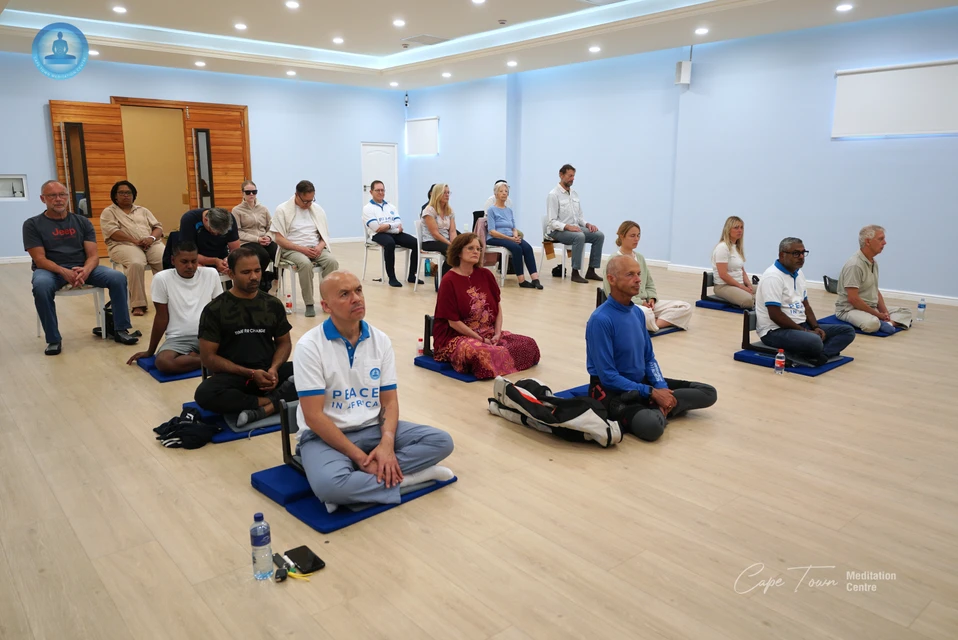
To understand why observation is important, let us return to the physical world.
Imagine living in a time when microscopes had not yet been developed.
You might look at a drop of water and see nothing unusual. You might observe a wound becoming infected without understanding exactly why. You might notice that certain illnesses spread from one person to another without knowing what causes them.
Some of the tiny organisms responsible for these processes were invisible to the naked eye.
However, as human beings developed more precise instruments, our understanding began to change.
With the help of microscopes, scientists became able to observe bacteria and other microorganisms. They could study their structures, behaviour, and interactions with their surroundings.
The important point is not simply that scientists discovered something new.
It is that they developed a method of observation that allowed them to see something that had always been there but had previously been beyond their ability to observe.
Precision is the key.
We can apply the same principle to our inner world.
We may not need a physical microscope to observe our minds, but we do need to develop the ability to pay attention carefully.
Consider what happens when someone says something unpleasant to us.
At first, we simply hear the words. Then we begin interpreting them. Perhaps we think, “That person does not respect me.”
A feeling of irritation or anger begins to arise.
Then the mind starts creating more thoughts. We remember previous arguments, imagine what we should have said, and begin preparing a response.
Before we realise it, a few unpleasant words have developed into an entire emotional experience.
But what if we could observe this process more carefully?
What if we could notice the first moment of irritation? What if we could recognise the thoughts that make the irritation stronger? And what if, instead of immediately reacting, we could pause and understand what was happening?
This is where mindfulness becomes important.
Mindfulness allows us to observe our experiences more clearly. Rather than trying to change everything immediately, we first learn to recognise what is happening as it happens.
4. Turning the Microscope Inward: The Practice of Mindfulness
In Buddhism, mindfulness is an important practice that helps us develop awareness of our experiences.
It allows us to observe the body, feelings, mental states, and phenomena with greater clarity.
Let us consider a simple example through meditation.
Imagine that you are sitting quietly, trying to meditate. You begin by paying attention to your breathing. You notice the air entering your body and the air leaving your body.
For a few moments, everything seems peaceful.
Then suddenly, a thought appears.
Perhaps you remember something you need to do tomorrow. You begin thinking about work. Then you remember a conversation from yesterday.
Before long, you realise that your attention is no longer on your breathing.
What should you do?
You might become frustrated with yourself and think, “I cannot meditate. My mind is too busy.”
However, mindfulness invites us to approach the situation differently.
Instead of fighting the thought, we simply recognise it.
We can silently acknowledge, “Thinking.”
Then we gently return our attention to the breath.
The thought itself is not necessarily a problem. The important thing is learning to recognise it without becoming completely carried away by it.
Through regular practice, we may gradually begin to recognise patterns in our thinking.
We may discover that certain thoughts repeatedly lead to anxiety. We may notice that certain desires create dissatisfaction. We may recognise that anger becomes stronger when we repeatedly think about the same unpleasant situation.
Through this observation, we begin to understand our own mental habits.
And when we understand these habits more clearly, we gain greater freedom to choose how we respond.
Mindfulness does not mean that we will never experience anger, sadness, or fear again.
Rather, it means gradually learning to recognise these experiences without automatically allowing them to control our actions.
In this way, mindfulness becomes a valuable tool for understanding our inner world.
5. The Five Precepts: Training the Mind Through Our Actions
If mindfulness helps us observe our minds, how can we support this practice in everyday life?
One important answer in Buddhism is ethical conduct.
In particular, the Five Precepts provide a foundation for training ourselves to live with greater care and awareness.
The Five Precepts are:
- To refrain from taking life – respecting and protecting living beings.
- To refrain from taking what is not given – respecting the belongings and rights of others.
- To refrain from sexual misconduct – behaving responsibly and respecting relationships.
- To refrain from false or harmful speech – speaking truthfully and avoiding words that cause harm.
- To refrain from intoxicants that lead to heedlessness – avoiding substances that weaken awareness and self-control.
These precepts are not simply rules designed to control our behaviour. They can also be understood as a form of mental training.
Let us consider the first precept as an example.
Imagine two people who regularly encounter animals.
One person treats animals with care and tries to avoid causing unnecessary suffering. Another person repeatedly harms animals without concern for their pain.
We should not assume that every person who hunts or harms an animal is necessarily cruel in every aspect of life. Human behaviour is complicated, and circumstances matter.
However, we can still recognise an important principle:
The actions we repeatedly perform can influence the habits we develop.
When we repeatedly act without concern for suffering, we may gradually become less sensitive to it.
On the other hand, when we practise compassion and restraint, we strengthen our ability to recognise the suffering of others.
The same principle applies to our speech.
Imagine that every time someone disagrees with us, we respond with harsh words. Over time, anger may become our usual response to disagreement.
But if we practise pausing, listening, and speaking carefully, we begin developing a different habit.
We become more capable of responding thoughtfully rather than reacting emotionally.
This is why ethical conduct and mindfulness support one another.
Mindfulness helps us recognise what is happening within our minds, while ethical conduct helps us guide our actions in ways that reduce harm and support a peaceful state of mind.
When our actions and speech become more careful, we may also find it easier to maintain mindfulness in everyday life.
The Five Precepts therefore serve not only as a foundation for Buddhist practice but also as practical guidance for living with greater awareness and responsibility.
6. From Inner Peace to Peace in the World

Now, let us return to our original question.
How can understanding the world and understanding our own minds contribute to peace?
Think about how conflicts often begin.
Sometimes they begin with a misunderstanding. Sometimes they begin with fear. Sometimes they begin because someone feels disrespected and reacts without taking the time to understand the situation.
One person’s anger influences another person’s response. Then the second person’s response makes the first person even angrier.
Before long, a small disagreement becomes a much larger conflict.
But imagine what might happen if even one person in that situation could pause.
Imagine if someone could recognise their anger without immediately acting on it.
Imagine if they could listen carefully before making assumptions.
Imagine if they could speak honestly without trying to hurt the other person.
That single moment of awareness might change the direction of the conversation.
It might not solve every problem, but it could prevent the situation from becoming worse.
This is how inner peace can influence the world around us.
Peace within ourselves does not mean ignoring injustice or avoiding difficult conversations.
It means learning to respond to difficult situations with greater clarity, compassion, and wisdom.
We cannot control every person we meet. We cannot control every event that happens in the world.
But we can work on the way we understand and respond to our own experiences.
And that is something we can begin practising today.
7. Peace Begins With Awareness
Through everything we have discussed, we can see how Dhamma, mindfulness, and ethical conduct are connected.
Through the teachings of Dhamma, we learn to look more deeply at reality.
Through mindfulness, we learn to observe our thoughts and feelings more clearly.
Through ethical conduct, we train ourselves to act and speak with greater care.
And through these practices, we can gradually cultivate a more peaceful relationship with ourselves and with others.
The world may not always be peaceful. Life may not always unfold the way we wish.
But we can begin by changing the way we meet each moment.
Before we finish, let us take a brief moment to relax.
Take a gentle breath in, and slowly breathe out.
Notice the feeling of your body. Notice the sounds around you. And simply observe what is happening in your mind.
You do not need to force yourself to feel peaceful. You do not need to push away every thought.
Just take a moment to become aware of your experience.
Perhaps this is a small example of what we have been discussing.
Just as we develop tools to understand the physical world, we can develop mindfulness to understand our inner world.
Peace is not only something that happens when the world becomes quiet. Sometimes, peace begins when we learn to become quiet enough to understand ourselves.
8. Guided Meditation: Cultivating Peace Within
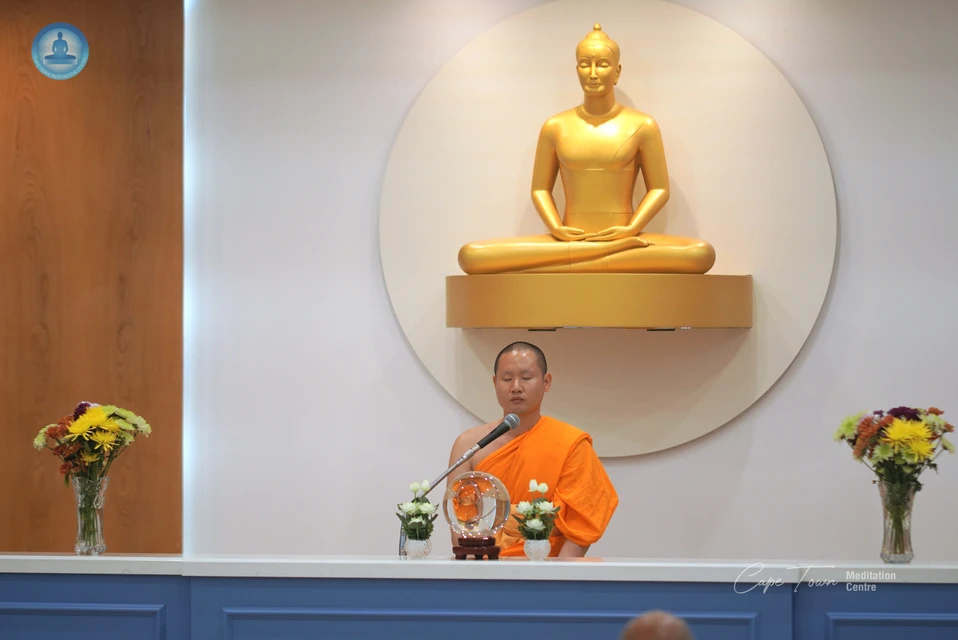
Following the Dhamma talk, participants were invited to experience a meditation session to put the ideas of mindfulness and inner peace into practice.
Step 1: Relaxing the Body
Begin by allowing the whole body to relax.
There is no need to rush to close your eyes. Take three gentle, deep breaths, breathing in and slowly breathing out.
Then gently close your eyes, as if you were falling asleep. Do not squeeze your eyelids shut.
Feel the relaxation spreading from the crown of your head down through your body.
Observe your shoulders. If they feel tense or raised, allow them to relax.
Let the whole body become soft and comfortable.
Step 2: Resting the Mind at the Centre of the Body
Imagine that your body is completely empty and filled with a sense of lightness.
Allow yourself to feel as though you are becoming one with the peaceful nature around you.
Gently allow your mind to rest at the centre of your abdomen.
There is nothing to force and nothing to rush. Simply enjoy the feeling of peacefulness arising from within.
Step 3: Visualising a Crystal Sphere
Softly imagine or feel an object resembling a crystal ball at the centre of your body.
Be comfortable with whatever appears. It does not need to be clear or bright.
Simply allow the image or feeling to remain gently in your awareness.
Step 4: Repeating the Mantra
Gently repeat the mantra:
Samma Arahang
Continue repeating it until the end of the meditation, or until you no longer feel the need to do so.
When the mind becomes still, you may simply sit in silence.
There is no need to return to the mantra if the mind is already peaceful.
Allow your mind to rest gently with the image of the object at the centre of your body.
Just be.
Step 5: Extending Loving-Kindness to All Living Beings
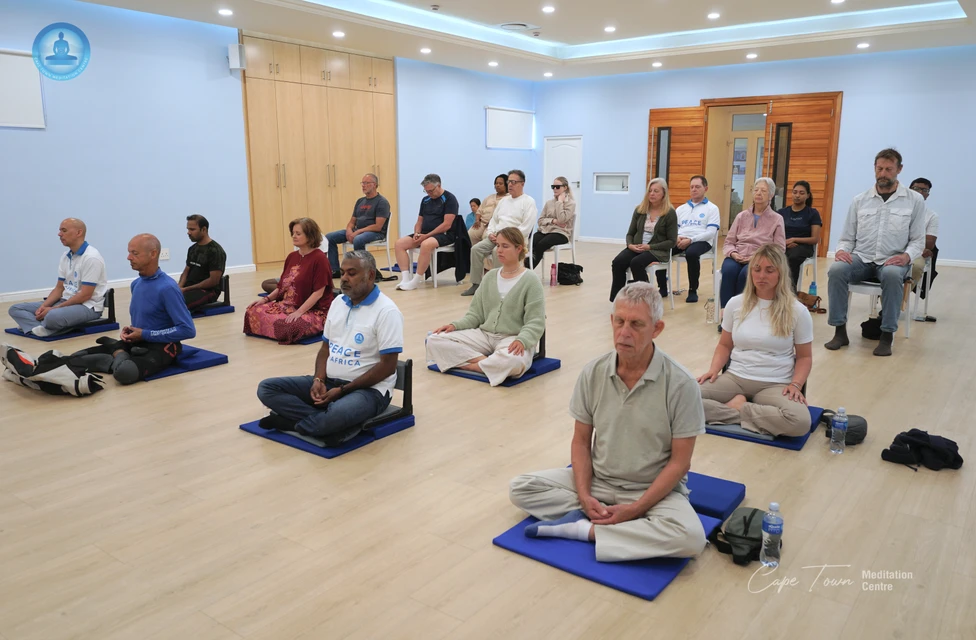
As the meditation comes towards its conclusion, imagine the crystal sphere at the centre of your body gently expanding until it encompasses your whole body.
Feel its peaceful light and energy extending beyond you.
Allow this peaceful feeling to spread throughout the surrounding area, across the entire city, and eventually throughout the whole world.
Silently extend your good wishes to all living beings:
- May all living beings feel this peaceful energy and our good intentions.
- May all living beings who are suffering find peace.
- May all living beings who are peaceful remain peaceful forevermore.
- May everyone live in peace and harmony.
Take a moment to enjoy this feeling of kindness and peacefulness.
Closing Reflection
At the end of the meditation, participants were invited to reflect on their experience.
Did you feel relaxed? Did you experience a sense of peace? Did you feel a sense of brightness from within?
Whatever your experience may have been, remember that meditation is a process of learning and practising.
There is no need to force a particular result.
Every time we practise observing ourselves, relaxing the mind, and returning to the present moment, we are developing greater awareness.
Thank you for joining us. We hope to see you again at Cape Town Meditation Centre.
May we all continue to cultivate peace within ourselves and share that peace with the world.
