

How the Practice of Giving Can Reduce Stinginess, Develop a Happy Mind, and Bring More Peace Into Our Lives
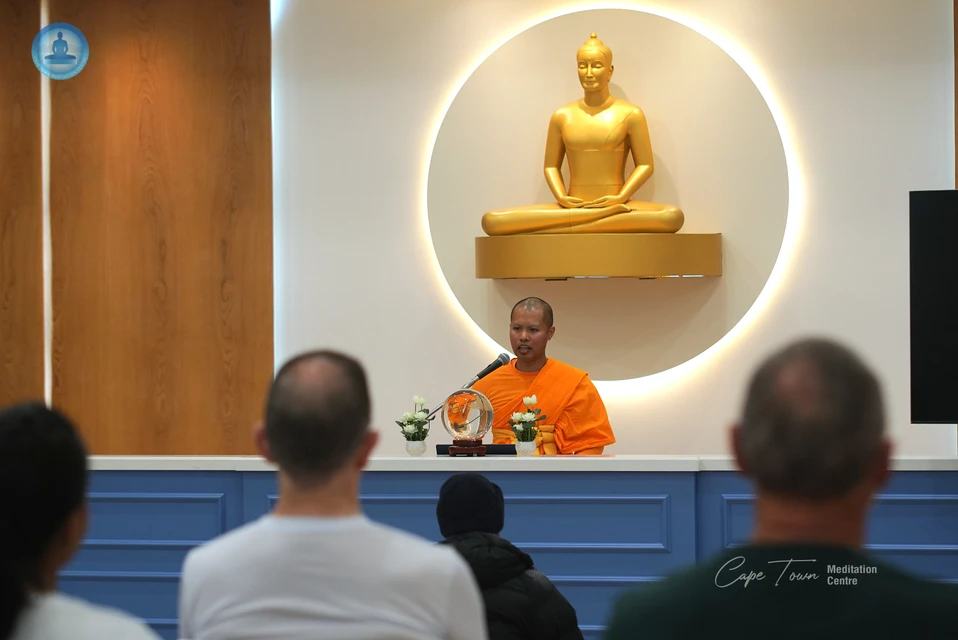
Giving and sharing are important parts of human life. They help make our world a kinder, happier, and more caring place. From the moment we are born, we depend on the kindness and support of others. In the same way, our willingness to give and share can make a meaningful difference in the lives of those around us.
In Buddhism, giving is more than simply offering money or material things. It is an opportunity to cultivate goodness, reduce selfishness, and train the mind to become more generous and peaceful.
In this Dhamma talk, we explore the meaning of merit and demerit, the consequences of stinginess, and how we can use the simple act of giving to understand ourselves more deeply. Most importantly, we will learn how to practise generosity before, during, and after giving, so that the happiness of giving can continue to benefit our minds long after the act itself has ended.
1. Why Is Giving So Important?
Giving and sharing are what make our world full of life. Without generosity, the world would become a difficult and lonely place to live.
Consider our own lives. If our mothers had not carried us in their wombs, we would never have been born. After we were born, if nobody had cared for us, fed us, or helped us grow, we would not have survived until today.
We cannot be born and grow up entirely by ourselves. Throughout our lives, we depend on other people in countless ways. Someone provides our food, someone teaches us, someone helps us when we are in trouble, and someone offers us kindness when we need encouragement.
This shows us that giving is not something separate from life. It is part of what allows life and society to continue.
In Buddhism, giving and sharing are considered important good deeds that everyone can practise. We do not need to be rich to become generous. We can share our time, knowledge, food, belongings, encouragement, or kindness with others.
The important point is that we learn to think beyond ourselves and become willing to share what we have.
2. What Is Merit, and Why Does It Bring Happiness?
Besides helping others, giving has another important benefit in Buddhism: it is a way to accumulate merit.
Merit can be understood as positive energy cultivated in the mind through good actions, such as giving, keeping the Five Precepts, and practising meditation.
We can often experience the happiness of doing good immediately. When we help someone, share something with another person, or make a sincere offering, we may feel joyful, peaceful, and light-hearted.
That happiness is one of the ways we experience the goodness of our actions.
However, the results of merit do not necessarily appear immediately. They take time, just as a seed needs time to grow into a tree and produce fruit.
When we plant a seed, we may not see anything happen at first. Yet, with the right conditions and proper care, the seed can grow and eventually produce many fruits.
Similarly, Buddhist teachings explain that the results of merit can multiply and appear in different forms. These may include a long life, good health, a pleasant appearance, wealth, prosperity, a good reputation, and wisdom.
Think about planting a single fruit seed. When the tree grows, it may produce hundreds of fruits. We can eat them, sell them, or share them with others. The leaves may be used to make compost, while the wood may serve other useful purposes.
From one seed, many different benefits can arise.
In the same way, a single good deed may bring many beneficial results over time.
The Buddha taught:
“Sukho puññassa uccayo.”
This means:
“The accumulation of merit brings happiness.”
This teaching reminds us that doing good is valuable not only because of the immediate happiness it brings but also because it helps cultivate positive qualities in our minds and lives.
3. Understanding Stinginess and Demerit

If giving is beneficial, what happens when we refuse to give or share?
In everyday life, we may describe someone who never wants to share as selfish or lacking kindness. Such behaviour can make relationships difficult and cause unhappiness for the people around them.
From the Buddhist point of view, the problem goes deeper than the outward action. It also involves the state of the mind.
Sometimes, we refuse to give because we are afraid of losing what we have. We may worry that if we share our belongings or money, we will have less for ourselves. We may feel reluctant to help others because we are too focused on protecting our own interests.
This is called stinginess.
In Buddhism, stinginess is a type of mental defilement. It can cover the mind and make us less willing to understand or care for others. If we continually follow this tendency, we may become increasingly selfish, cold-hearted, and unwilling to help anyone.
When we act out of greed, anger, or delusion, we create demerit.
Demerit can be understood as negative mental energy arising from unwholesome actions and intentions. Just as merit is associated with positive results, Buddhist teachings explain that demerit can bring negative results.
These results may not appear immediately. They may take time to arise, and their effects can extend into different areas of life.
According to Buddhist teachings, the demerit arising from stinginess can lead to difficulties concerning wealth, health, appearance, social relationships, and opportunities.
A person may work hard but still experience repeated difficulties in making a living. Things that should be straightforward may become complicated, and relationships with others may become strained.
Such difficulties can create further problems. When someone struggles to obtain food or money to survive, they may be tempted to act without considering moral principles. They might steal, exploit others, or cause harm.
These additional unwholesome actions can create even more suffering.
This illustrates an important lesson: when we continually follow negative mental habits, they can influence our behaviour and create a cycle of further difficulties.
By learning to recognise stinginess and practising generosity, we can begin to change that pattern.
4. A Buddhist Story About the Consequences of Stinginess
A story from the time of the Buddha illustrates the dangers of extreme stinginess.
According to the Buddhist account, there was once a wealthy man named Ananda who was extremely stingy. Although he possessed great wealth, he did not want to share it. His stinginess was so strong that he even taught his family members, children, and servants to behave in the same way.
After his death, the story says that he was reborn as the child of a family of outcasts.
Even while the child was still in his mother’s womb, the family experienced great difficulties. His mother and her companions went out to work but could not earn money. Even when they begged for food or money, they received nothing.
When the child was born, the account described him as having a severely deformed and unpleasant appearance.

This story is traditionally used to illustrate the consequences of extreme stinginess and the importance of cultivating generosity.
Its purpose is to encourage us to reflect on our own behaviour. Do we use what we have only for ourselves, or are we willing to share with others? Do we feel happy when others receive something good, or do we feel uncomfortable when we have to give something away?
We do not need to wait until we have great wealth to practise generosity. We can start with small things in our everyday lives.
The sooner we learn to let go of stinginess, the sooner we can begin developing a more generous and peaceful mind.
5. Giving Is More Than Making a Donation
Buddhists commonly practise giving as a way to make merit. One simple example is offering food, necessities, or other useful items to monks.
The physical act of giving may take only a few moments. We prepare something, offer it, and the act is complete.
However, we can use this simple opportunity to develop ourselves much more deeply.
Instead of focusing only on what we give, we can observe what happens inside our minds.
Are we happy before giving? Do we feel regret while giving? After giving, do we keep thinking about what we have lost? Do we secretly expect something in return?
By observing these feelings, we can learn about our attachments, expectations, and habits of thinking.
This turns giving into a practical exercise in understanding and training the mind.
We can practise by observing three important moments: before giving, while giving, and after giving.
Moment 1: Before Giving — Set a Good Intention
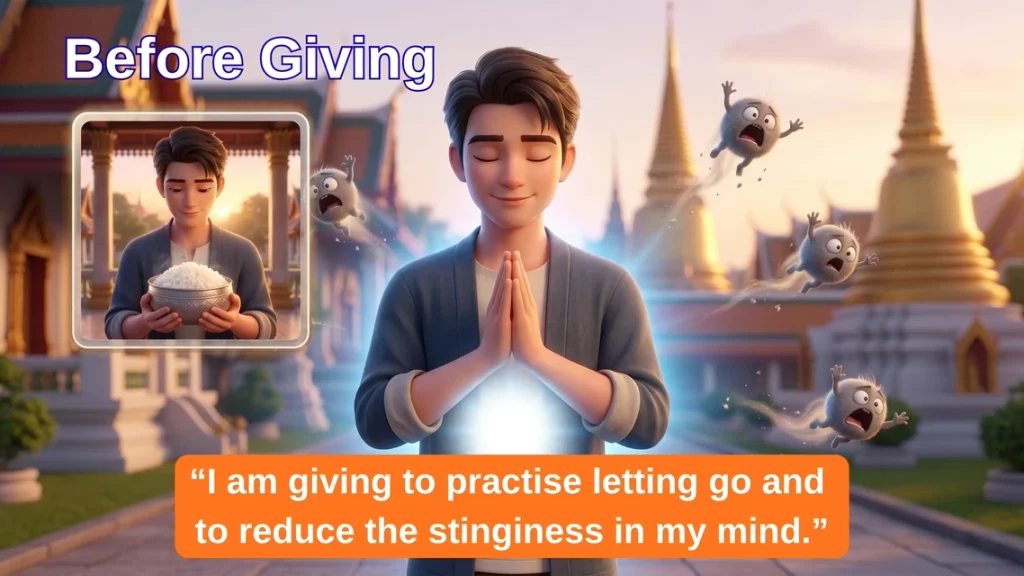
Before giving something, pause for a moment and establish a clear intention.
We can remind ourselves:
“I am giving to practise letting go and to reduce the stinginess in my mind.”
This intention helps us understand that giving is not only about helping the recipient. It is also about training ourselves to become less attached to material things.
After setting our intention, we can prepare the items we wish to give and make ourselves ready with a happy heart.
There is no need to rush or feel pressured. We can prepare carefully and remind ourselves that we have an opportunity to do something good.
For example, if we are preparing food for someone, we can choose and arrange it with care. If we are making a donation, we can decide what we are comfortable giving and do so willingly.
The important thing is to begin with a sincere intention and a mind that is ready to share.
Moment 2: While Giving — Give With Respect

When we give, we should give with respect.
First, we respect our own decision. We have chosen to give, so we can carry out that decision with a clear and willing mind.
Second, we respect the things we have prepared. Even if an item is inexpensive, we can offer it with care rather than treating the act casually.
Third, we respect the dignity of the person receiving our gift. Giving should not make the recipient feel inferior or indebted to us. We are sharing something, not using it to show that we are better than someone else.
We should also avoid forcing ourselves to give more than we can comfortably afford. Generosity should be practised wisely and willingly, rather than through pressure or fear.
When we give with respect, we can feel comfortable with our decision and appreciate the goodness of the action.
The same principle applies when we participate in ceremonies or charitable activities connected with different religious or cultural traditions. We do not need to make giving complicated or become unnecessarily worried simply because the ceremony is unfamiliar to us.
The essential practice is to give with a good intention, respect, and a willing heart.
Moment 3: After Giving — Rejoice Without Expecting Anything in Return

After giving, the next step is just as important.
Once we have given something, we should practise letting go of our expectations.
We do not need to wait for the recipient to praise us, thank us repeatedly, or give us something in return. We do not need to keep reminding others of what we have done.
Instead, we can appreciate our own effort.
We can feel happy that we have overcome some of our stinginess and have been able to share something with another person.
This is a small but meaningful victory.
Whenever we remember the good deed, we can bring that happiness back into our minds. We can feel joyful that we made a good decision and followed through with it.
In this way, the happiness of giving does not have to end when the ceremony or activity is over.
We can continue to rejoice in the goodness of our actions.
6. What If We Feel Regret or Expect Something in Return?
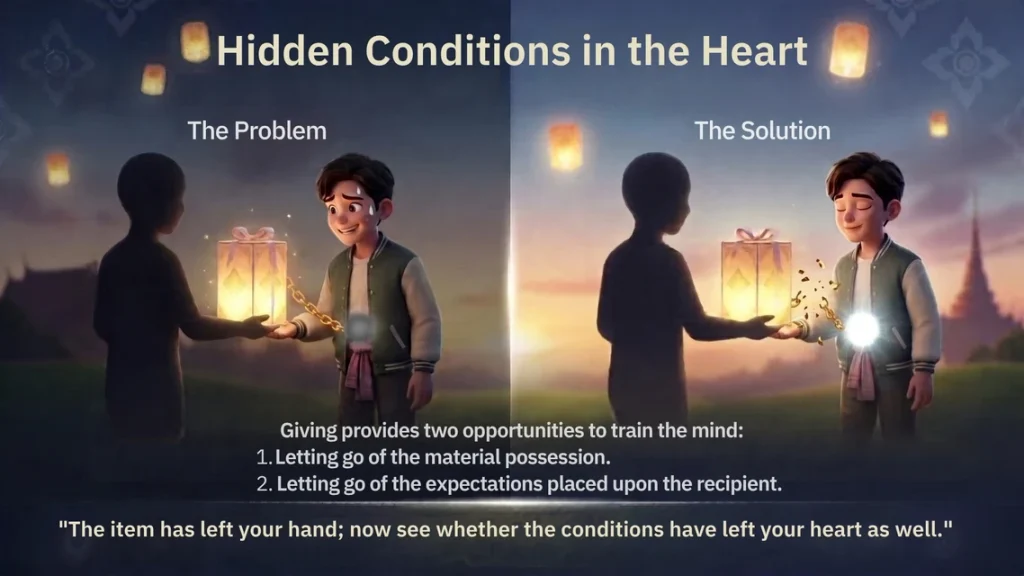
Sometimes, even after deciding to give, we may feel hesitant or uncomfortable.
Perhaps we regret giving away an item. Perhaps we wonder whether we should have donated less. Or perhaps we begin thinking about what we should receive in return.
These feelings can tell us something important: our minds may still be holding on.
Sometimes, we are attached to the material thing itself. At other times, we are attached to the person receiving it or to the results we expect from the act of giving.
Consider this example.
You buy a gift for your child. However, deep inside, you expect your child to behave better because of that gift. If your child does not change, you may feel disappointed and think, “After everything I have done, why are you still behaving this way?”
Another example is making an offering to monks while expecting the merit to make us wealthy in return.
These thoughts are understandable. In everyday life, we are familiar with exchanging one thing for another. We often give something because we hope to receive a benefit in return.
However, this is an opportunity to examine our minds more carefully.
We can ask ourselves:
“Am I giving while still holding on, or am I truly practising letting go?”
There is no need to criticise ourselves when we discover that we still have expectations.
Simply recognise what is happening.
We can say to ourselves:
“My mind is still holding on to something.”
If we look more deeply, we may recognise that our attachment and expectations come from habitual ways of thinking. Our minds want to control the outcome and make sure that we receive something in return.
Once we recognise this tendency, we can gently let go of the thought and return to our original intention:
“I am giving to practise letting go and to reduce the stinginess in my mind.”
The purpose is not to force ourselves to feel happy or pretend that we have no attachment. The purpose is to understand our minds and gradually learn how to release that attachment.
Through this practice, we can become less dependent on external things and other people’s responses for our happiness.
We begin to discover a sense of freedom, lightness, and peace within ourselves.
7. Moment 4: Continue the Practice After Returning Home

Although we have discussed three moments of giving, there is another useful step: continuing the practice after the act of giving is over.
Even after we have returned home, we can remember the happiness we experienced after giving.
When we recall our good deed, we can rejoice in it again. We can remember that we shared something willingly and practised letting go of our attachment.
Our minds may feel lighter because we are no longer holding on so tightly to the things we gave away or the expectations we decided to release.
This practice can also support our meditation.
When the mind is less burdened by regret, attachment, and expectations, it may become easier to sit quietly and meditate. Our thoughts may settle more quickly, allowing the mind to become calm and focused.
When we repeatedly practise letting go, we gradually learn not to follow every thought or feeling that arises.
Instead of continually thinking about what we have lost, what we want, or what others should do for us, we can return our attention to the present moment.
As we continue to cultivate generosity, wholesome intentions, and meditation, we develop positive qualities within the mind.
In Buddhist teachings, the accumulation of merit is understood to support beneficial results in life. Good opportunities, helpful relationships, and favourable circumstances may arise in different ways. Sometimes, we may discover solutions or opportunities that we did not expect.
The important lesson is that we should not practise generosity merely to obtain rewards. We practise because giving is good, because it helps others, and because it trains our minds to become less selfish and more peaceful.
When we combine generosity with the practice of meditation, we develop both a kind heart and a calm mind.
8. Bringing Generosity Into Everyday Life
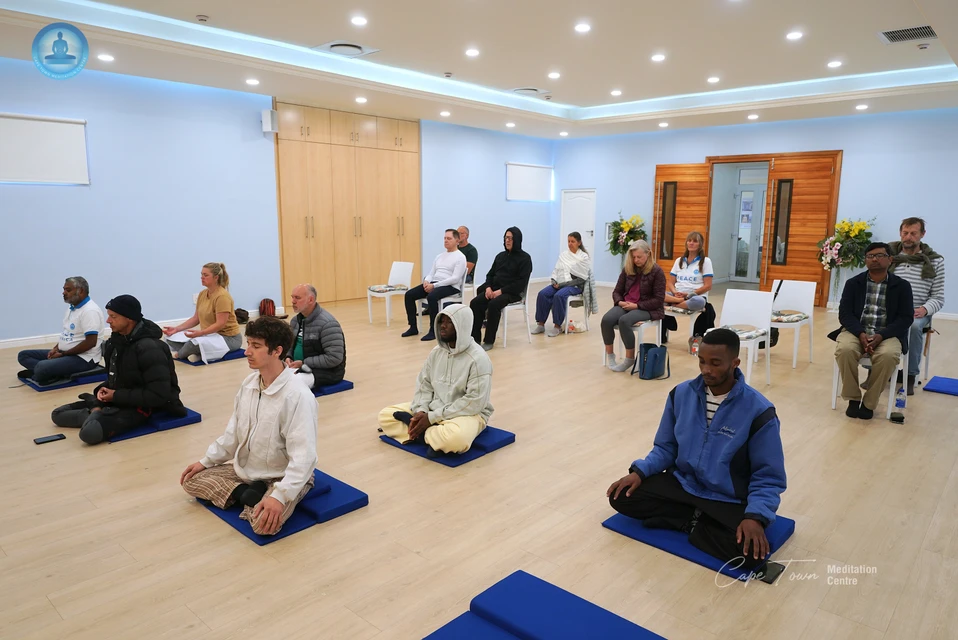
The practice of giving before, during, and after an act of generosity can be applied to almost every area of our lives.
At home, we can share responsibilities, offer our time to family members, or help someone without expecting praise.
At work, we can share our knowledge, support a colleague, or offer assistance when someone is struggling.
Among friends, we can listen patiently, encourage one another, and share what we have when someone needs help.
Generosity is not limited to money or material possessions. Sometimes, giving someone our time and attention is just as meaningful.
Whenever we give, we can remember these three moments:
- Before giving: Set a good intention and prepare with a happy heart.
- While giving: Give willingly, respectfully, and without forcing ourselves.
- After giving: Let go of expectations and rejoice in the goodness of our actions.
Then, continue the practice by remembering the happiness of giving and allowing it to nourish the mind.
Over time, these simple actions can help us recognise stinginess more quickly, become less attached to material things, and develop a more generous attitude towards others.
9. Join Us for Upcoming Merit-Making Events
At Cape Town Meditation Centre, we welcome everyone to practise generosity, cultivate goodness, and learn how to bring peace into daily life.
There are also opportunities to put these teachings into practice through our upcoming merit-making events.
End of Buddhist Lent Alms-Giving Ceremony — Sunday, 25 October 2026
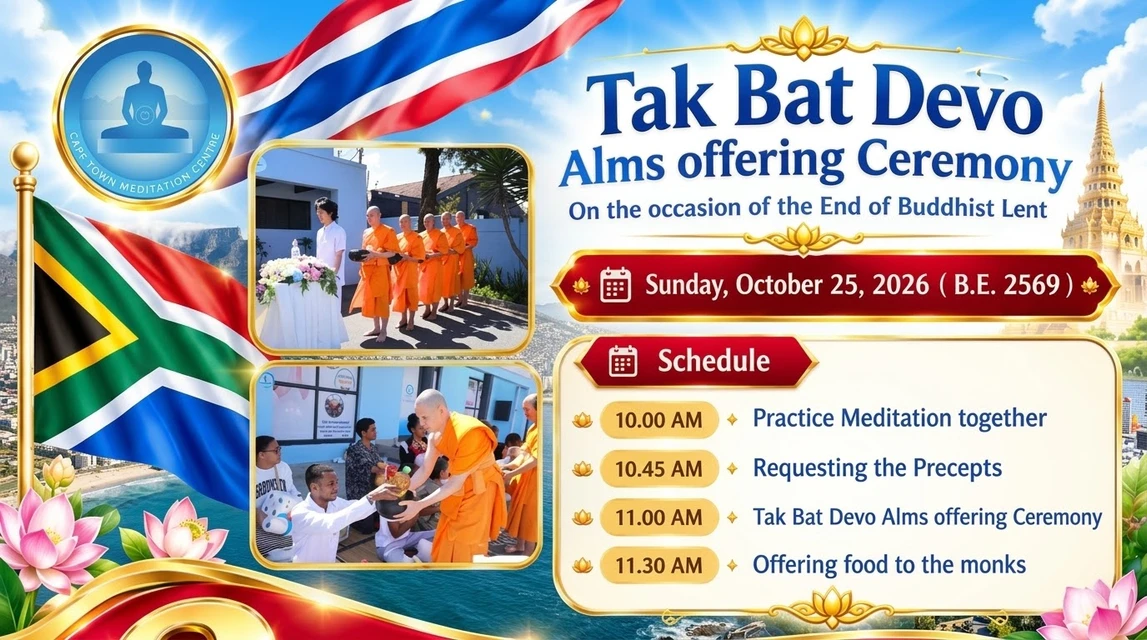
Buddhists also know this traditional alms-giving ceremony as Tak Bat Devo. It is an opportunity to offer food to monks, practise generosity, and share the joy of making merit with the community.
Unity Kathina Ceremony — Sunday, 15 November 2026
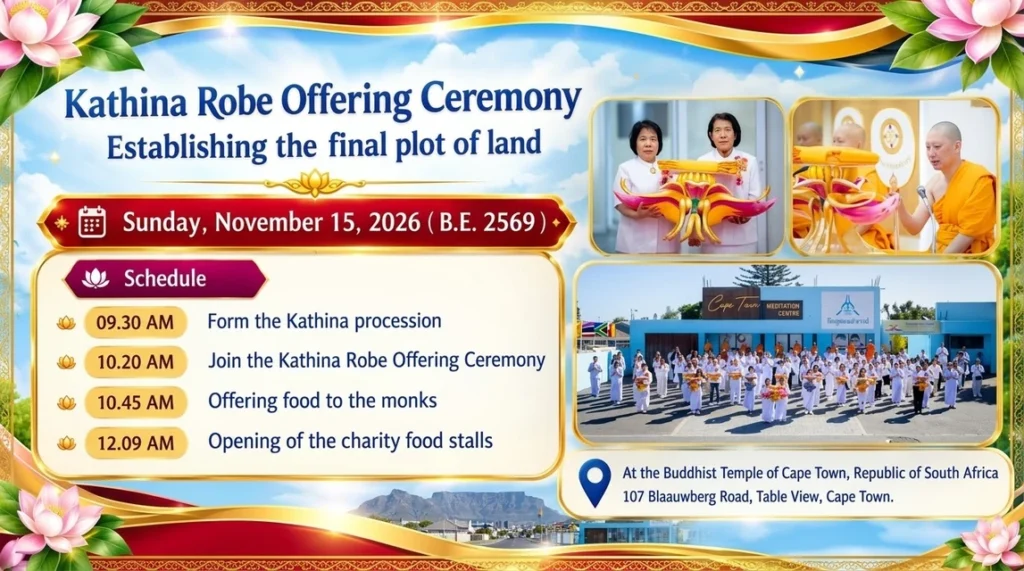
Kathina is an important annual Buddhist tradition in which laypeople come together to offer robes and support the monastic community. It is also an opportunity to cultivate generosity, cooperation, and unity.
Everyone is warmly invited to join us in these special occasions.
Let us use these opportunities not only to give material things but also to develop our minds.
Before giving, establish a good intention. While giving, offer with respect and a happy heart. After giving, rejoice in the good deed without expecting anything in return.
Most importantly, continue practising generosity in our everyday lives.
The more we learn to let go of stinginess and unnecessary expectations, the more space we create for kindness, happiness, and peace within ourselves.
May our generosity bring happiness to ourselves and others. May we continue to cultivate merit, develop wisdom, and discover the joy of a mind that is free from attachment.
We look forward to welcoming you to Cape Town Meditation Centre.
