

A healthy body makes it easier for the mind to become calm.
When the body is weak or sick, the mind is easily disturbed.
That is why caring for the body is not just a physical matter—it is the foundation of inner peace.
From the moment we are born until the day we pass away, the body is constantly changing.
Every minute, millions of cells die, and new cells are created to replace them.
In children, this process happens faster. As we age, it slows down.
This natural decline cannot be avoided, but it can be cared for wisely.
The body works through a simple but delicate balance.
Food is digested into nutrients for the cells.
Air is breathed in to support life.
Cells use food and oxygen to create energy, warmth, and movement.
At the same time, waste is produced and must be removed from the body as feces and urine.
When this whole process stays in balance, the body remains healthy and illness is less likely to arise.
But when the balance is disturbed, discomfort and disease appear—and the mind suffers along with the body.
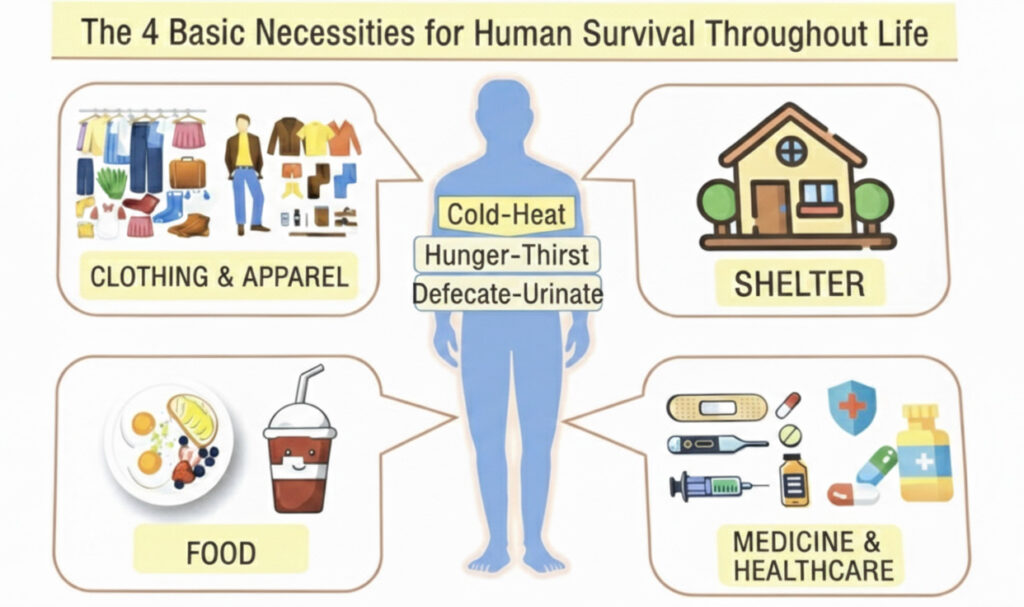
The body functions best at a normal temperature of around 37°C.
Too much heat or too much cold affects cells, enzymes, and the immune system.
This is why we need proper clothing and suitable shelter.
The body also needs food and water every day.
Hunger and thirst remind us of this need.
We must eat and drink in the right amount, with awareness, good nutrition, and cleanliness.
Today, although medicine has advanced, many people suffer more from lifestyle-related diseases caused by unmindful eating.
Another important aspect is waste elimination.
The body produces waste in many forms, and it must be released regularly.
Holding it in for too long creates discomfort and illness.
Cleanliness after elimination is also part of caring for the body.
In Buddhism, these unavoidable bodily conditions are known as the Six Apatha—
heat, cold, hunger, thirst, urination, and defecation.
They are natural conditions of human life.
They cannot be removed, but they can be managed with mindfulness and care.
When we neglect the body, sickness arises.
When sickness arises, the mind becomes restless, irritated, and unhappy.
Medical costs increase, stress increases, and mental suffering follows.
Because of this, humans depend on the Four Requisites:
clothing, shelter, food, and medicine.
If we manage them without mindfulness—without moderation and care—
they become another source of stress, conflict, and suffering.
A restless mind, burdened by bodily discomfort and constant struggle,
often misunderstands happiness.
It believes happiness comes only from sights, sounds, tastes, smells, and touch.
This belief leads to endless wanting, competition, and conflict—
from individuals to families, to society, and even the whole world.
When suffering begins at the level of the body and mind,
it expands outward.
That is why the world’s problems are the sum of individual problems.
So the solution must begin at the starting point—ourselves.
When we care for the body with awareness,
the mind becomes lighter and calmer.
Meditation becomes easier.
Inner stillness becomes possible.
By nurturing the body,
we allow the soul to become sabai—relaxed, at ease, and peaceful.
