

The Four Keys to Inner Peace
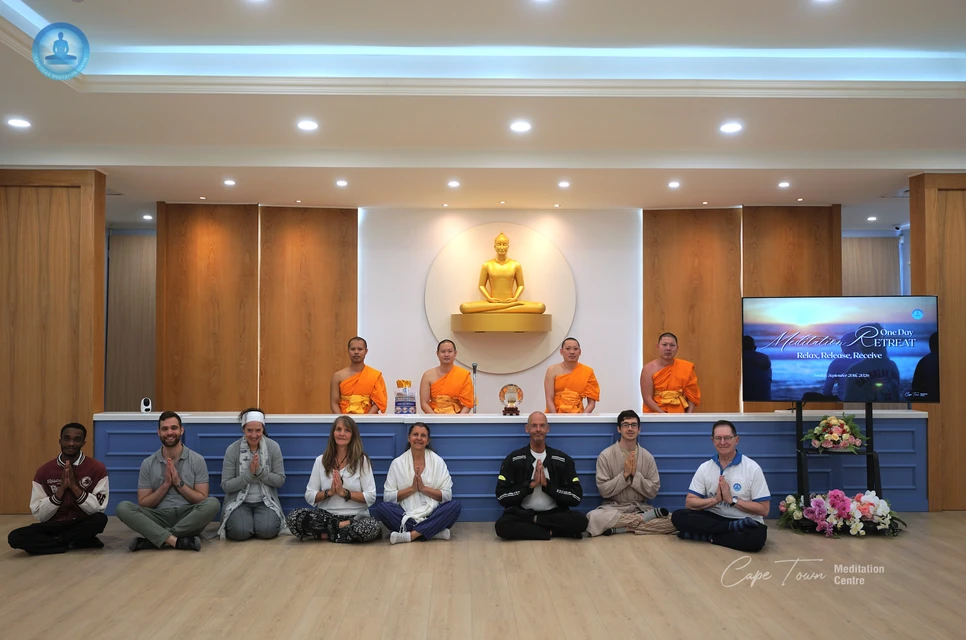
A one-day meditation retreat is an opportunity to step away from the busyness of everyday life and return to something simple: the mind.
At the Cape Town Meditation Centre, a recent One-Day Meditation Retreat explored the foundations of Middle Way Meditation through three Dhamma talks given throughout the day.
The retreat followed a natural progression through the Four S’s of meditation:
- Sati — Mindfulness or Consciousness
- Sabaai — Comfort
- Samam-semeo — Consistency
- Sang-ket — Observation
These four principles work together as a practical system for developing inner peace. Sati brings the mind back home, Sabaai keeps the practice gentle and comfortable, Samam-semeo develops continuity through daily practice, and Sang-ket helps us observe and adjust our practice with kindness.
The three talks guided participants from understanding the wandering mind, to discovering inner comfort, and finally to developing a consistent practice that can continue throughout everyday life.
Morning Talk: Sati — Bringing the Mind Back Home
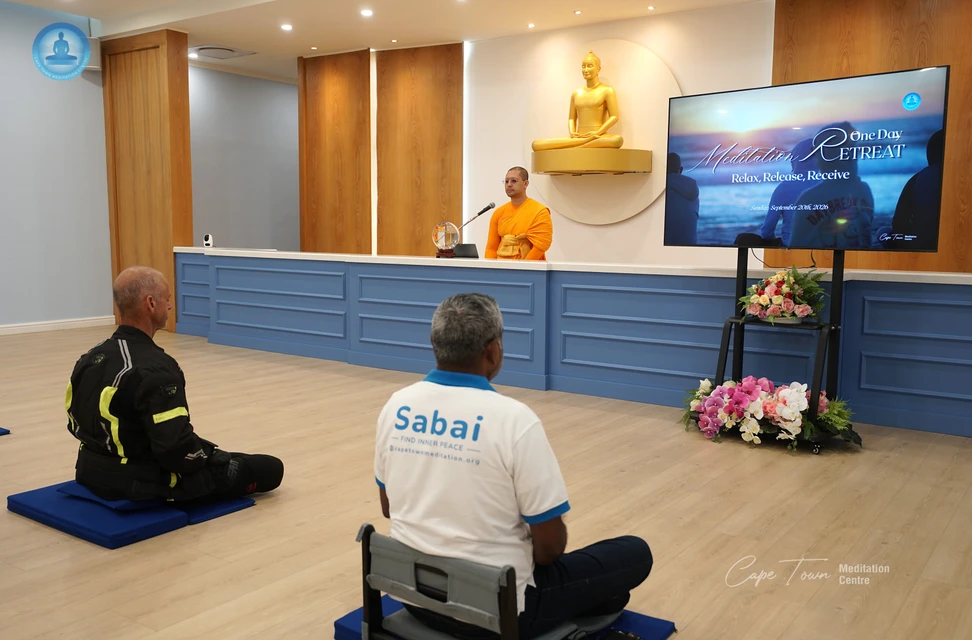
The retreat began with a warm welcome from Monk Magnum, who invited everyone to take some peaceful time together and consider a simple but important question:
How can we bring the mind back to ourselves?
In everyday life, our attention is constantly pulled outward.
We have work, responsibilities, family matters, messages, plans, memories, and countless things competing for our attention. Even when the body is sitting in one place, the mind may be somewhere completely different.
Meditation provides an opportunity to bring that wandering mind back.
However, meditation is not about forcing the mind into an uncomfortable state. It is about learning how to allow the mind to rest peacefully inside the body.
In Middle Way Meditation, this begins with Sati.
The Four S’s
The tradition of Middle Way Meditation teaches four essential principles, known in Thai as:
สติ — Sati
สบาย — Sabaai
สม่ำเสมอ — Samam-semeo
สังเกต — Sang-ket
They can be understood in English as:
Mindfulness, Comfort, Consistency, and Observation.
Although all four principles work together, the foundation begins with Sati.
What Is Sati?
Sati is often translated as mindfulness, but in this meditation practice it has a very practical meaning.
It means bringing the wandering mind back inside the body, to its true home.
The human mind can be compared to a wild or untamed horse that has spent its life running freely in an open field.
When we first try to catch the horse, it naturally wants to run away.
The same thing can happen when we close our eyes and sit quietly.
Suddenly, the mind remembers yesterday.
Then it thinks about what we need to cook for dinner.
Then it remembers something that needs to be done at work tomorrow.
One thought leads to another, and before we know it, the mind has travelled far away from the meditation cushion.
Sati is the gentle awareness that notices this and brings the mind back.
It does not force the mind.
It does not fight the thoughts.
It simply remains aware.
The Parent and the Child
Another way to understand Sati is to imagine a parent watching a young child playing in a garden.
The parent does not need to shout at the child every few seconds.
They simply keep an eye on the child.
When the child wanders too close to the fence, the parent gently calls them back.
Sati works in the same way.
We allow the mind to move naturally, but we remain aware of where it is.
When it wanders too far into thoughts and distractions, we gently bring it home.
Why Is Mindfulness Important?
Without Sati, the mind can easily be pulled around by every emotion and distraction.
We may react immediately when something goes wrong.
We may become angry, anxious, disappointed, or emotionally unsettled.
With Sati, we begin to notice what is happening inside before automatically reacting.
This gives us a moment of choice.
Instead of immediately following anger, we can choose calmness.
Instead of following anxiety, we can return to the present.
Instead of allowing endless thoughts to exhaust us, we can bring our awareness back to the body.
Sati therefore supports clearer thinking, calmer emotions, and greater relaxation.
Finding the Mind’s Home
In Middle Way Meditation, the natural home of the mind is described as the seventh base.
It is located at the center of the body, approximately two finger-breadths above the navel.
This area is regarded as an important center for developing inner peace.
However, beginners should not become tense trying to find the exact physical location.
Meditation is a practice of gentle feeling.
There is no need to search inside the body with force.
Instead, simply allow your awareness to rest around the middle of the abdomen, at a place where you feel comfortable and relaxed.
For now, that is your center.
Whenever the mind rests there, it becomes less interested in following every distraction outside.
Two Tools for Anchoring the Mind
To help the mind remain at the center, we can use two practical tools.
The first is visualization.
Imagine a clear, bright crystal sphere resting gently at the center of your body.
If a crystal sphere does not feel natural to you, you can imagine another round object that feels peaceful and comfortable.
The purpose is not to create a perfect image.
The purpose is simply to give the mind a peaceful place to rest.
The second tool is a mantra.
As you gently hold the image at the center, silently repeat:
“Samma Arahang.”
The mantra is not spoken aloud.
Instead, allow it to arise quietly within the mind, almost like a gentle whisper coming from the center of the body.
The visualization and mantra give the wandering mind something peaceful to stay with.
As the mind becomes quieter, the mantra may gradually fade naturally, leaving behind a clearer awareness at the center.
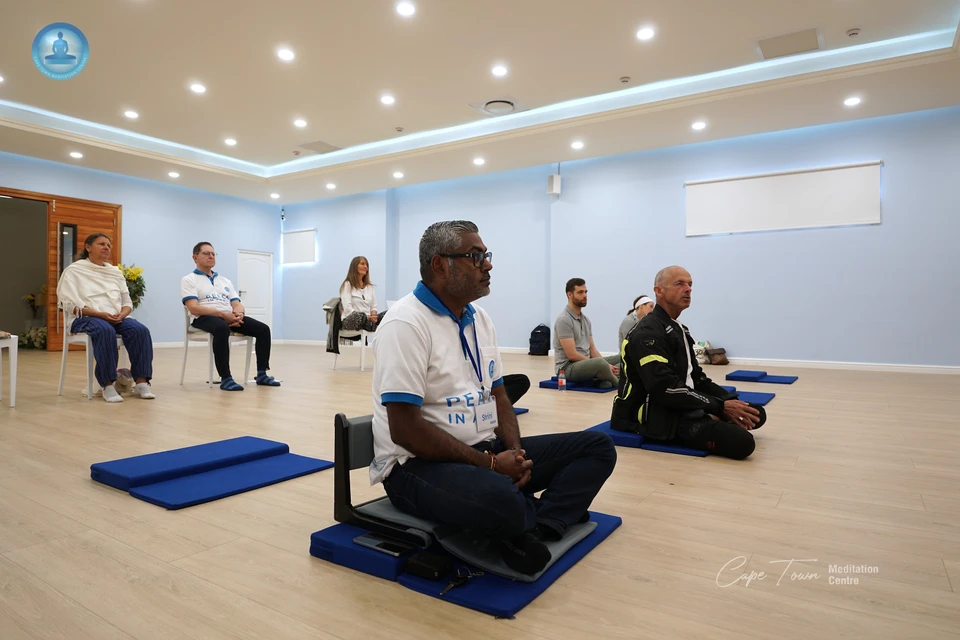
Practising Sati in Daily Life
Sati does not begin only when we sit down to meditate.
It begins with our daily habits.
Simple things such as keeping our living space clean and tidy can support a calm and organized mind.
We can also introduce small moments of mindfulness throughout the day.
For example, once every hour, pause for one quiet minute.
Take a deep breath.
Release tension.
Bring your awareness back to the center of your body.
Then continue with whatever you were doing.
These small moments help keep the mind close to home throughout the day.
When we later sit down for formal meditation, the mind is already familiar with returning to the center.
The Second Key: Sabaai — Effortless Ease
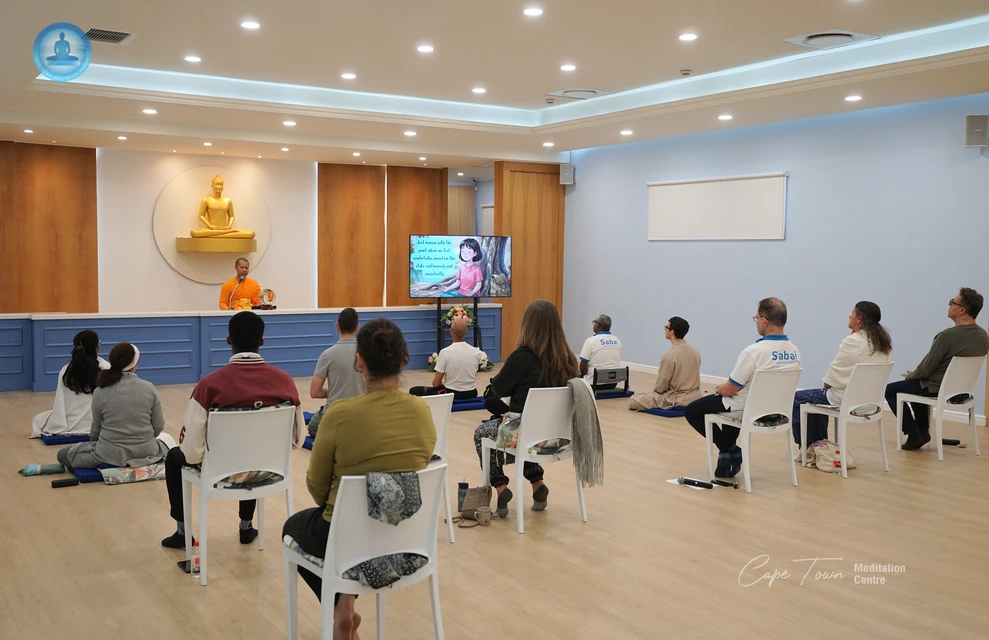
The late-morning Dhamma talk, By Monk Tong, continued the retreat by exploring the second principle: Sabaai, or Comfort.
The talk began with a simple question:
When you hear the word “comfort,” what comes to mind?
Perhaps a bed.
A sofa.
A comfortable living room.
A cup of coffee.
Something soft and relaxing.
Most of these things are external sources of comfort.
But meditation invites us to consider another possibility:
What if we could become our own source of comfort?
What if comfort did not always depend on what was happening around us?
Rediscovering Inner Comfort
Modern life constantly pulls our attention in different directions.
We may begin to associate happiness with achieving more, owning more, experiencing more, receiving recognition, or finding more entertainment.
As we chase these external things, we can gradually forget the simple source of happiness that already exists within us.
Meditation gives us an opportunity to reconnect with that inner comfort.
There are two levels of comfort that can be experienced in meditation:
- Initial Comfort
- True Comfort
Initial Comfort
Initial comfort means that we are no longer struggling.
We are not tense.
We are not forcing anything.
We are simply still.
This does not necessarily mean that we feel great happiness yet.
It is more like a neutral, peaceful state.
Imagine walking through a hot desert under strong sunlight.
You become exhausted.
Then you find a tree and sit under its shade.
You may not immediately feel wonderful.
But compared with standing under the hot sun, you can simply think:
“Ah, this is good enough for now.”
The same thing can happen when we begin meditation.
Perhaps we arrived after a stressful day at work.
Our body was tense.
Our mind was busy.
Now we are sitting quietly.
Maybe we do not feel deep happiness yet.
That is perfectly fine.
For now, this peaceful neutrality is enough.
We simply maintain it.
We don’t demand more from ourselves.
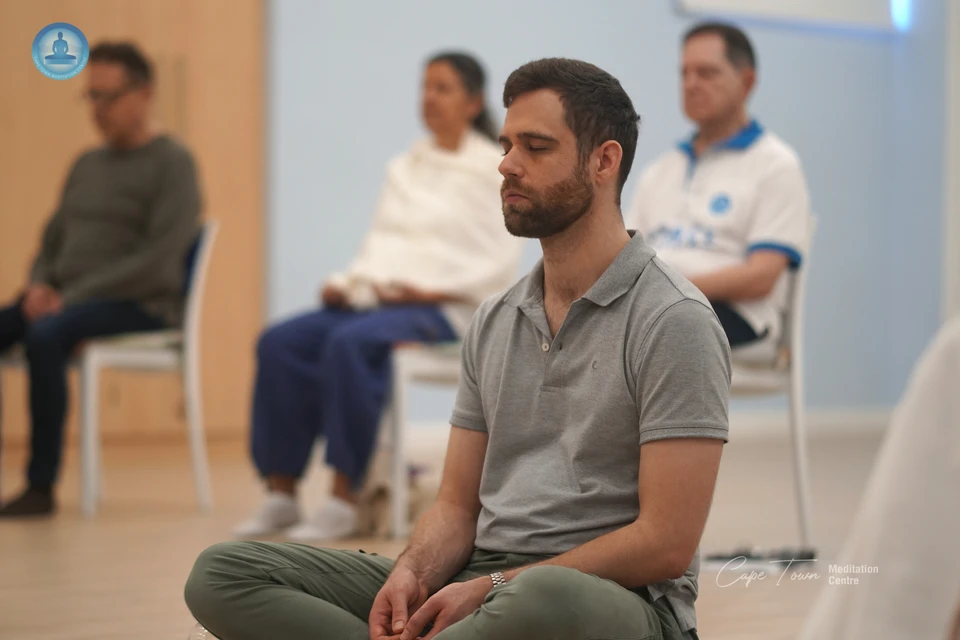
From Initial Comfort to True Comfort
When we maintain this peaceful state continuously, something may begin to change naturally.
We may feel more open.
More spacious.
Lighter.
Cooler.
More refreshed.
The mind becomes quieter, and thoughts no longer disturb us as easily.
This is what the teaching describes as True Comfort.
The experience can become increasingly subtle.
The body may feel lighter and more spacious.
Physical sensations may become less noticeable.
At times, the body may even seem almost weightless, as though there is no solid physical boundary.
However, an important point is introduced here:
Do not become attached to the experience.
The moment we begin thinking:
“I want it to be clearer.”
“I want to go deeper.”
“I want to experience more.”
“I want it to become better.”
we may disturb the very stillness we have developed.
Desire can pull the mind away from comfort.
So what should we do when something beautiful or subtle happens?
Return to normal.
Stay still.
Stay neutral.
Stay comfortable.
Do not become excited.
Do not try to make the experience stronger.
Simply allow it to be.
No Forcing, No Chasing, No Expectations
During meditation, an inner light or subtle image may sometimes appear.
If this happens, simply observe it.
Do not force it to become clearer.
Do not chase it.
Do not become excited.
Allow it to remain exactly as it is.
The principle is simple:
No forcing.
No chasing.
No expectations.
We simply remain comfortable and allow the meditation process to unfold naturally.
Practising Comfort Throughout the Day
Initial comfort is especially useful because we can practise it throughout the entire day.
We do not have to wait until we are sitting on a meditation cushion.
We can practise maintaining a comfortable state while:
- Walking
- Working
- Talking
- Driving
- Eating
- Doing household activities
Our mood and inner state affect our ability to maintain both mindfulness and comfort.
If the mind becomes upset, disappointed, irritated, or overly excited, it can easily lose its balance.
This is why we repeatedly return to the Middle Way.
We let go.
We forgive.
We do not hold tightly to the mistakes or imperfections of other people.
We do not need to focus continuously on what is wrong.
Instead, we can choose to return to a comfortable state of mind.
This is also meditation.
Meditation is not only what happens when our eyes are closed.
It is also the way we take care of the quality of our mind throughout the day.
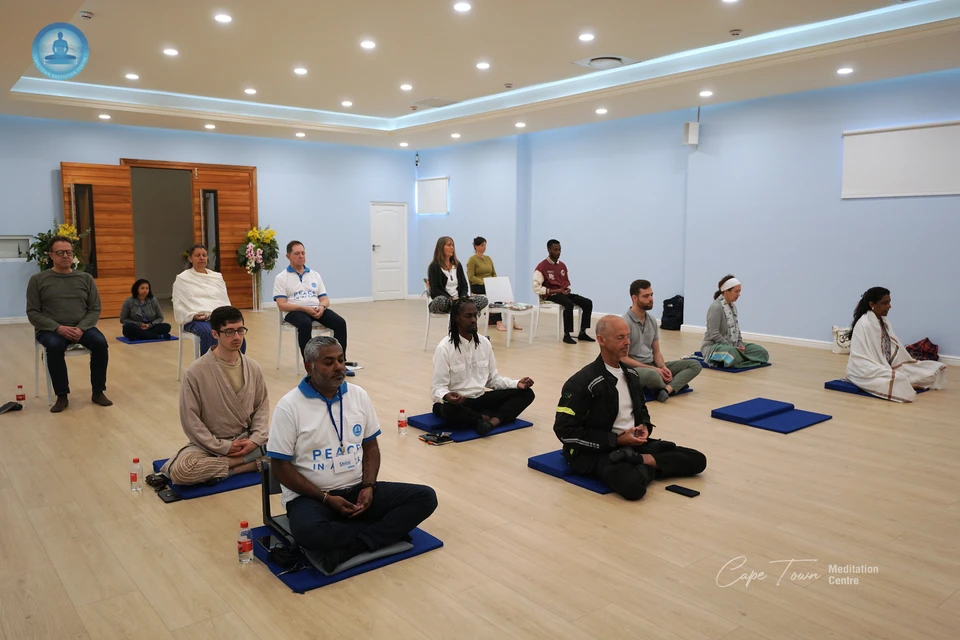
Building Our Inner Capital of Comfort
Every time we practise maintaining comfort, we are building what can be thought of as an inner capital of comfort.
Each peaceful moment becomes a resource that supports our future meditation.
When we eventually sit down to meditate, we can take the comfort we have already developed throughout the day and gently allow it to spread through the body.
We can imagine comfort beginning at the head and moving downward.
Or we can begin at the center of the body and allow the feeling to expand naturally in every direction.
There is no need to force it.
We simply allow comfort to grow.
We can think of ourselves as the center from which comfort, happiness, goodness, and good wishes can arise.
When we find a place where we feel comfortably still, we remain there.
We do not need to constantly question:
“Is this exactly the right place?”
“Am I in the correct position?”
“Is this the correct center?”
If we feel comfortably still, that is enough.
Be content with what is present right now.
Don’t demand something better.
Take care of the comfort that is already there.
Then allow the mind and body to naturally do what they know how to do.
This is the essence of Effortless Ease.
Afternoon Talk: Consistency and Observation
The final Dhamma talk of the retreat brought the first two principles together and introduced the remaining two keys:
Samam-semeo — Consistency
and
Sang-ket — Observation.
The morning session introduced Sati, bringing the mind home.
The late-morning session explored Sabaai, learning to remain comfortable and relaxed.
Now the retreat moved toward a practical question:
How can we make inner peace a lasting part of our lives?
The answer begins with consistency.
The Third Key: Samam-semeo — Consistency
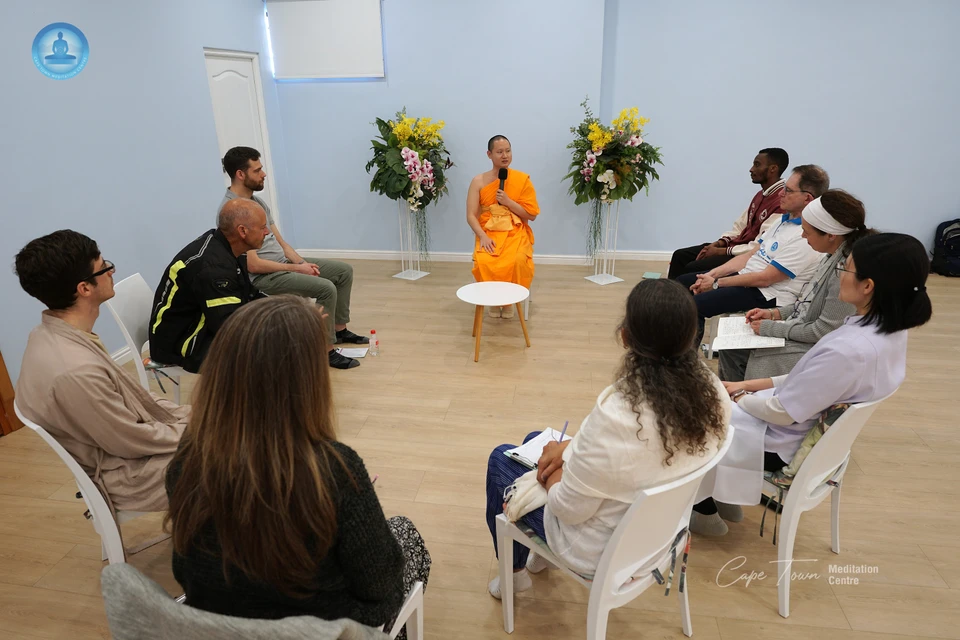
Consistency means making meditation a regular part of daily life.
Imagine trying to boil a pot of cold water.
If you turn on the fire for two minutes and then turn it off, the water will remain cold.
If you wait three days and turn it on for only one minute, the water still will not boil.
To boil the water, we need a continuous fire.
Meditation works in a similar way.
If we meditate for two hours on Sunday but completely forget about our center for the rest of the week, it becomes difficult to maintain inner peace.
The mind becomes busy with external concerns again.
Consistency keeps the inner fire burning.
Meditation as Flight Hours
Another useful comparison is an airplane pilot.
A pilot cannot become skilled simply by reading about flying.
They need actual hours in the air.
In the same way, meditation develops through practice.
Every minute we spend returning the mind to the center becomes another kind of inner “flight hour.”
The more experience we gain, the more naturally the mind learns how to settle.
Small Daily Practice
Consistency does not necessarily mean sitting for hours every day.
A short practice done regularly can be very valuable.
For example, we can set aside fifteen minutes every morning.
The important thing is to make it a habit.
A small amount of practice every day can be more sustainable than a very long session once in a while.
The teaching gives another beautiful image:
Small drops of water falling continuously into a bucket will eventually fill the whole bucket.
In the same way, small moments of meditation can gradually fill the heart with peace and happiness.
Taking Meditation Into Daily Activities
Consistency also means carrying our meditation into ordinary activities.
Meditation does not end when we stand up from the cushion.
We can continue to remember our center while walking along the beach, driving through Cape Town, washing dishes, sweeping the floor, or preparing food for our family.
Imagine a spider sitting quietly at the center of its web.
The spider remains still at the center while remaining aware of everything happening around it.
We can develop something similar.
We can remain connected to our center while participating fully in everyday life.
When we sweep, we sweep with a peaceful mind.
When we cook, we cook with a peaceful center.
When we walk, we walk while remaining connected to ourselves.
The One-Minute Meditation Break
One simple practice introduced during the retreat was to take a one-minute meditation break every hour.
When a new hour begins:
Pause.
Take a gentle breath.
Smile softly.
Feel the center of the body.
Remain there for approximately sixty seconds.
Then continue with your day.
This small practice helps refresh the mind and keeps our inner awareness alive.
Another practical habit is keeping our room and surroundings clean and organized.
A neat outer environment can support a calm and bright inner environment.
These may seem like small things, but consistency is built from small things repeated regularly.

The Fourth Key: Sang-ket — Wise Observation
The fourth principle is Sang-ket, or Wise Observation.
Sang-ket means gently checking our inner state to see whether we are practising in a balanced way.
This is important because meditation can sometimes move away from the Middle Way without us noticing.
A useful comparison is an old radio.
When you turn the dial, if you move too far in one direction, you hear static.
If you move too far in the other direction, you also hear static.
You need to gently adjust the dial until the music becomes clear.
Sang-ket is like our inner radio tuner.
It helps us recognize when the mind is too tight or too loose.
When the Mind Is Too Tight
The first common problem is trying too hard.
Perhaps we desperately want to see inner light.
We squeeze our eyes.
We concentrate strongly.
We tense the forehead.
We create pressure in the head.
Sang-ket helps us notice:
“My mind is too tight.”
The answer is to add more Sabaai.
Relax.
Soften.
Let go.
Return to comfort.
When the Mind Is Too Loose
The opposite problem is becoming too relaxed.
We may lose awareness of the center.
Thoughts take over.
We begin daydreaming.
Or we become sleepy and drift away.
Sang-ket helps us notice:
“My mind is too loose.”
The answer is to bring back a little more Sati.
Return to the center.
Become gently aware again.
The goal is not extreme concentration or extreme relaxation.
The goal is balance.
Sati and Sabaai walk together.
Be a Good Spectator, Not the Director
One of the most important lessons in Wise Observation is how to observe without judging ourselves.
Imagine sitting in a movie theatre.
You are a spectator.
You are not the director.
You do not need to jump onto the screen and change every scene.
Meditation can be approached in the same way.
When a thought appears, simply observe it.
A thought about work may appear.
A memory may appear.
A worry about home may appear.
Let it pass.
You can imagine thoughts as clouds moving across the sky.
You don’t need to fight the clouds.
You don’t need to become angry because they appeared.
Simply watch them pass.
Then gently bring the mind back home.
Even if you have to do this many times, there is no failure.
The moment you notice that the mind has wandered is already a moment of Sati.
When Darkness Appears
Sometimes, when we close our eyes, there may be nothing but darkness.
Sang-ket teaches us not to become impatient with this.
We can treat the darkness as a peaceful friend.
Imagine sitting outside on a quiet night in South Africa, under a calm and spacious sky.
There is nothing wrong with the darkness.
We can simply rest comfortably within it.
Just as every sunrise comes after the darkness of night, the inner light can appear naturally when the mind is ready.
We don’t need to force it.
We simply remain comfortable and patient.
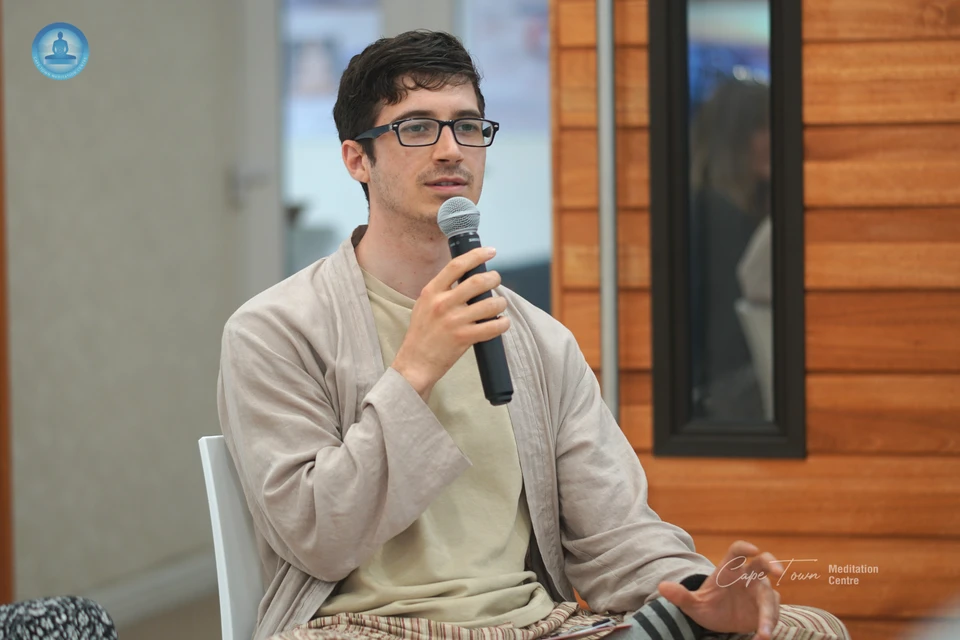
The Power of “Set Zero”
What happens when we realize that we have been lost in thought for a long time?
What happens when we notice that we have been forcing our eyes or creating tension?
This is where Set Zero becomes useful.
Set Zero means resetting the mind.
We let go of the past.
We do not waste energy feeling disappointed about the previous few minutes.
We do not tell ourselves:
“I am bad at meditation.”
“I have wasted my time.”
“I can’t do this.”
Instead, we simply smile gently and begin again.
Take a breath.
Relax the shoulders.
Feel the center of the body.
Return to Sati.
Return to Sabaai.
Start fresh.
We can Set Zero once, ten times, or even one hundred times during a meditation session.
Every time we recognize that we have wandered and gently return, we are practising.
There is no wasted moment when we learn from it.
The Four Keys Working Together
By the end of the One-Day Meditation Retreat, the four principles formed a complete picture.
Sati — Mindfulness
Bring the mind home.
Sati gently returns our awareness to the center of the body.
Sabaai — Comfort
Stay relaxed and balanced.
Sabaai prevents us from pushing too hard and helps the mind remain light and comfortable.
Samam-semeo — Consistency
Keep practising.
Consistency turns meditation from something we occasionally do into a natural part of everyday life.
Sang-ket — Observation
Check with kindness.
Observation helps us recognize when the mind is too tight or too loose and guides us back toward balance.
These four principles support one another.
If we have Sati without Sabaai, we may become tense.
If we have Sabaai without Sati, we may become sleepy.
If we have both but lack consistency, our progress may not become stable.
And without observation, we may not notice when we have moved away from balance.
Together, they create a complete approach to meditation.
From Stillness to Inner Peace
When Sati, Sabaai, Samam-semeo, and Sang-ket work together, the mind can gradually become more still.
The mind begins to settle into the center of the body.
In the teaching, this settling is described as “Tok Suan”—the mind dropping or settling into its true home.
From this stillness, the meditation tradition describes the possibility of experiencing a bright, pure crystal-like inner light.
More importantly, the practice develops a deeper sense of peace, happiness, and kindness that can gradually extend beyond the meditation cushion.
The purpose is not simply to have a peaceful experience during a retreat.
The purpose is to carry that peaceful quality into everyday life.
We can take it with us when we drive through Cape Town.
When we work.
When we speak with our family.
When we meet someone who makes a mistake.
When something unexpected happens.
When life becomes difficult.
The peaceful center we develop in meditation can become a place we return to again and again.
A One-Day Retreat, A Daily Practice

To conclude the one day meditation retreat, the participants joined in on a profound Silent Beach Walking Meditation at Bloubergstrand Beach. Moving slowly across the sand at allowed us to experience the “Golden Hour” in a state of total presence.
Meditation is not limited to sitting with closed eyes.
Meditation can happen while walking, working, listening, or interacting with others.
Peace becomes part of daily life.
The retreat may have lasted only one day, but the practice does not need to end when the retreat is over.
The real practice begins when we return to ordinary life.
We can remember:
Sati: Bring the mind home.
Sabaai: Stay comfortable.
Samam-semeo: Practise consistently.
Sang-ket: Observe with kindness.
And when we lose our way:
Set Zero.
Smile.
Relax.
Begin again.
There is no need to chase inner peace.
There is no need to force the mind.
There is no need to become frustrated when thoughts arise.
We simply keep returning.
Little by little, moment by moment, the mind learns where home is.
And perhaps, through consistent practice, we discover that the peace we have been looking for outside ourselves has been quietly waiting within us all along.
May our practice of Sati, Sabaai, Samam-semeo, and Sang-ket bring greater peace, happiness, kindness, and inner fulfillment to ourselves and to those around us.
